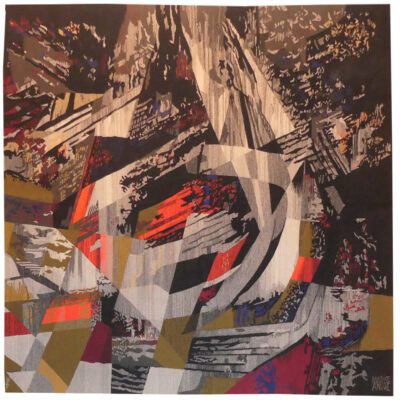
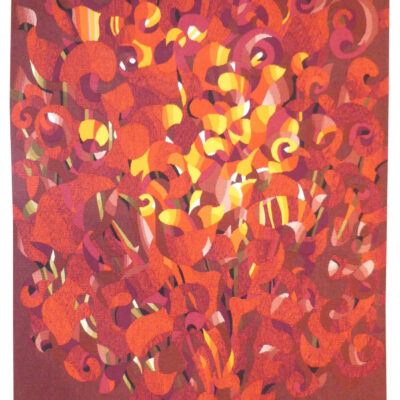
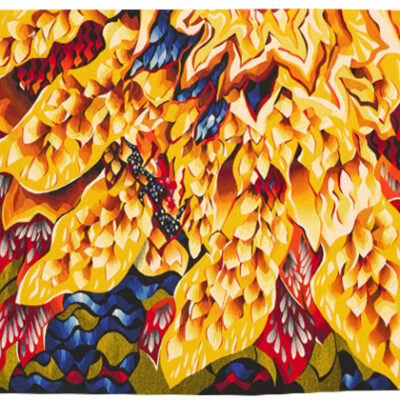
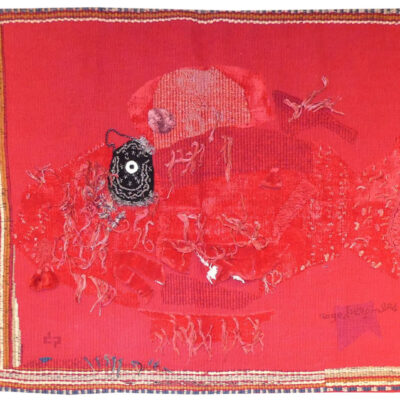
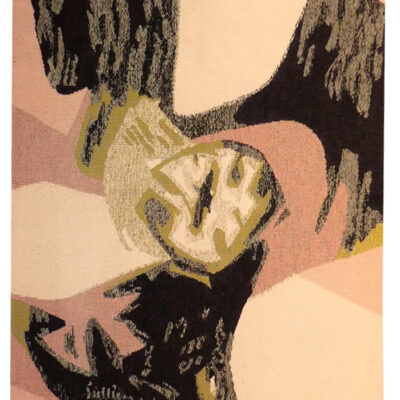
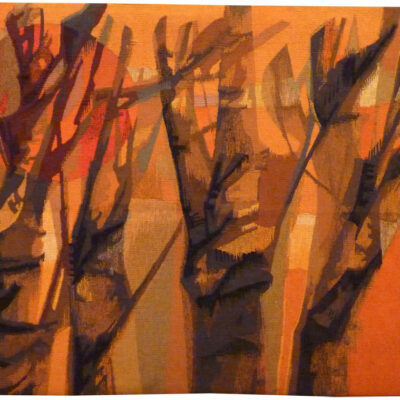
Aubusson tapestry woven by the Pinton workshop.
With its ribbon.
Circa 1965.
Maurice André stayed in Aubusson throughout the war. Founder of the cooperative group "Tapisserie de France" and member of the A.P.C.T. (Association of Tapestry Painters and Designers), he developed a personal aesthetic, far removed from Lurçat's, consisting of rigorous cubist flat colors in an often refined color palette, and received ambitious public commissions for the Council of Europe in Strasbourg ( "Europe United in Work and Peace") and the French Pavilion for the 1958 Exhibition in Brussels ("Modern Technology at the Service of Man"). Quite naturally (and like Wogensky, Prassinos, etc.), he then moved towards abstraction, initially in a rather lyrical style, then in an increasingly geometric style, following a trajectory very similar to that of Matégot.
In the mid-1960s, André's style became closer to that of Matégot, where hammering, pricking, and stippling were the norm. In terms of its theme, treatment, color range, and format, our cardboard is similar to "Grand nocturne," kept at the Jean Lurçat Museum and the contemporary tapestry in Angers.