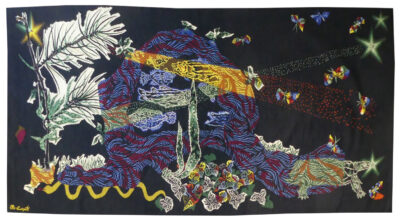
Aubusson tapestry woven by the Goubely-Gatien workshop.
With its ribbon signed by the artist.
Circa 1955.
Lurçat's body of work is immense, but it is his role in the revival of the art of tapestry that has ensured his place in history. He began working with canvas in 1917, then collaborated with Marie Cuttoli in the 1920s and 1930s. His first collaboration with Les Gobelins dates back to 1937, when he discovered the Apocalypse tapestry in Angers, which inspired him to devote himself entirely to tapestry. He first tackled the technical issues with François Tabard, then, when he moved to Aubusson during the war, he defined his own system: large stitches, counted tones, numbered cartoons. A huge production then began (more than 1,000 cartoons), amplified by his desire to involve his painter friends, the creation of the A.P.C.T. (Association des Peintres-Cartonniers de Tapisserie) and his collaboration with the La Demeure gallery and Denise Majorel, then by his role as a tireless promoter of the medium throughout the world.
His woven work bears witness to a specifically decorative art of imagery, in a highly personal, cosmogonic symbolic iconography (sun, planets, zodiac, four elements, etc.), stylized plants, animals (goats, roosters, butterflies, chimeras, etc.), stand out against a background without perspective (deliberately distanced from painting) and, in his most ambitious cartoons, are intended to share a vision that is both poetic (he sometimes embellishes these tapestries with quotations) and philosophical (the major themes were addressed as early as the war: freedom, resistance, fraternity, truth, etc.) and whose culmination was to be the "Chant du Monde" (Jean Lurçat Museum, former Saint-Jean Hospital, Angers), which was unfinished at the time of his death.
To his traditional scattered motifs (stars, fish, butterflies, etc.), Lurçat added two intersecting rays of light (hence the title) that alter the colors along their path: there could be no better way to show that the sun can be a danger to tapestry (another cartoon, "Coup de soleil" (formerly in our possession) illustrates the theme even more explicitly).
Bibliography:
Tapisseries de Jean Lurçat 1939-1957, Pierre Vorms Editeur, 1957
Exhibition catalog: Lurçat, 10 ans après, Musée d'Art moderne de la ville de Paris, 1976
Cat. Expo. Les domaines de Jean Lurçat, Angers, Musée Jean Lurçat et de la tapisserie contemporaine, 1986
Colloque Jean Lurçat et la renaissance de la tapisserie à Aubusson, Aubusson, Musée départemental de la Tapisserie, 1992
Exhibition catalog. Dialogues avec Lurçat, Museums of Lower Normandy, 1992
Exhibition catalog. Jean Lurçat, Donation Simone Lurçat, Academy of Fine Arts, 2004
Gérard Denizeau, Jean Lurçat, Liénart, 2013
Exhibition catalog: Jean Lurçat, Meister der französischen Moderne, Halle, Kunsthalle, 2016
Exhibition catalog: Jean Lurçat au seul bruit du soleil, Paris, Galerie des Gobelins, 2016