
Perrot René

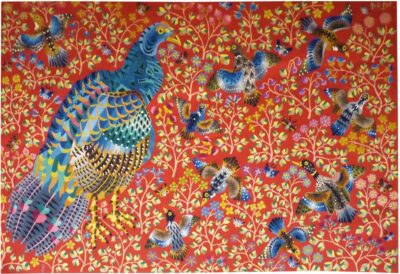
  • La roue

    Tapisserie d’Aubusson tissée par Pinton. Avec son bolduc. Circa 1970.
    Perrot commence son oeuvre de cartonnier à l’issue de la guerre, réalisant près de 500 cartons, avec de nombreuses commandes de l’Etat, la plupart tissées à Aubusson. Son style éminemment décoratif et chatoyant est très caractéristique : un foisonnement de papillons ou d’oiseaux , le plus souvent, se détache sur un fond végétal, dans le goût des tapisseries mille-fleurs (dont s’inspirera aussi Dom Robert). Fond kaki, inspiration des millefleurs médiévales, oiseaux fourmillants, tous les éléments propres aux cartons de Perrot sont ici réunis.
    Bibliographie : Tapisserie, dessins, peintures, gravures de René Perrot, Dessein et Tolra, 1982
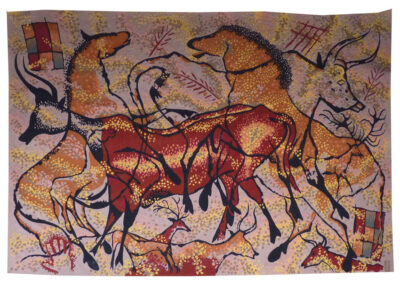
  • Hommage à l’abbé Breuil

       
    Tapisserie d’Aubusson tissée par l’atelier Pinton. Avec son bolduc. Circa 1955.
         
    Perrot commence son oeuvre de cartonnier à l’issue de la guerre, réalisant près de 500 cartons, avec de nombreuses commandes de l’Etat, la plupart tissées à Aubusson. Son style éminemment décoratif et chatoyant est très caractéristique : un foisonnement de papillons ou d’oiseaux , le plus souvent, se détache sur un fond végétal, dans le goût des tapisseries mille-fleurs (dont s’inspirera aussi Dom Robert). Etonnant carton inspiré des peintures de la grotte de Lascaux, où la tapisserie n’a jamais autant mérité son nom d’art pariétal ; la part de Perrot y est finalement assez modeste : saturation des couleurs (notamment du fond, entre parme et rose), densification des motifs (plus éparpillés dans la grotte), tavelures étalées,…Si Perrot a multiplié les cartons –hommages ( à Pergaud, à Redouté, à Audubon,….), celui-ci vaut surtout pour la proximité avérée de l’artiste et du dédicataire, « le pape de la Préhistoire » : l’hommage ne tient pas ici qu’à l’artificialité d’une commande publique.   Bibliographie : Tapisserie, dessins, peintures, gravures de René Perrot, Dessein et Tolra, 1982.
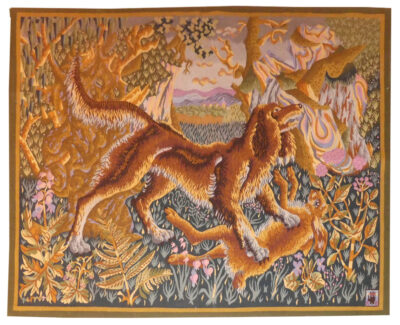
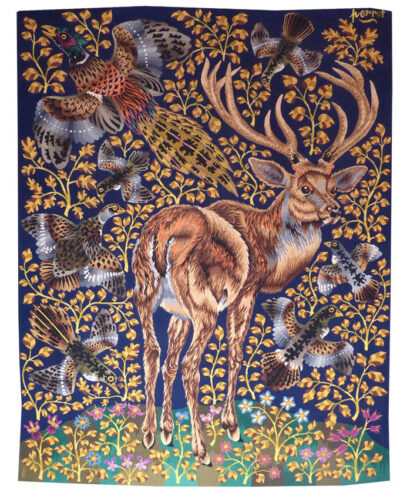
  • Rambouillet

    Aubusson tapestry woven by the Pinton workshop With its ribbon signed by the artist, no. 1/6. Circa 1970. Perrot began his work as a designer after the war, producing nearly 500 designs, with numerous commissions from the state, most of which were woven in Aubusson. His eminently decorative and shimmering style is very characteristic: a profusion of butterflies or birds, most often, stands out against a vegetal background, in the style of mille-fleurs tapestries (which also inspired Dom Robert). René Perrot is essentially an animal artist, who usually stylizes. His decorative vein is counterbalanced here by the extremely realistic treatment of the deer, unusual in post-war tapestry. The title of the cartoon refers to the great French hunts that he illustrated extensively, for example in "Sologne," deposited at the Musée de la Chasse in Gien by the Mobilier National.    
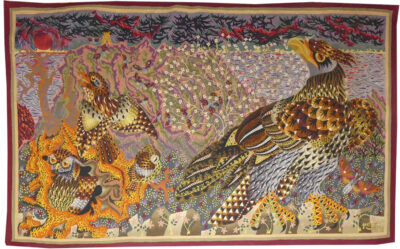
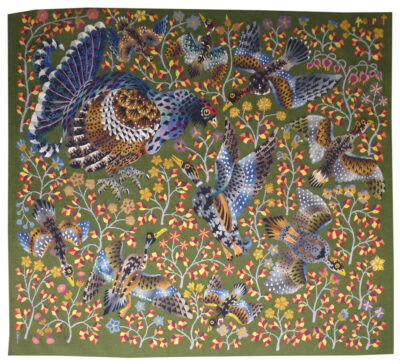
  • The law

     
    Aubusson tapestry woven by the Rivière des Borderies workshop. With its ribbon. 1951.
        Perrot began his work as a cartoonist after the war, producing nearly 500 cartoons, with numerous commissions from the state, most of which were woven in Aubusson. His eminently decorative and shimmering style is very characteristic: a profusion of butterflies or birds, most often, stands out against a vegetal background, in the style of mille-fleurs tapestries (which also inspired Dom Robert).   Perrot's endless ornithological representations are capable of an extraordinary variety of allegories: for example, "discord" and "meditation" for the Palais de Justice in Paris, illustrated respectively by grouse and owls. Nothing here is more fitting than a majestic eagle with a stern gaze, inspiring respect, to embody "the Law." Bibliography: Tapestry, drawings, paintings, engravings by René Perrot, Dessein et Tolra, 1982  
  • Tauromachie

     
    Tapisserie d’Aubusson tissée par l’atelier Rivière des Borderies. 1946.
          Perrot commence son oeuvre de cartonnier à l’issue de la guerre, réalisant près de 500 cartons, avec de nombreuses commandes de l’Etat, la plupart tissées à Aubusson. Son style éminemment décoratif et chatoyant est très caractéristique :  un foisonnement de papillons ou d’oiseaux, le plus souvent, se détache sur un fond végétal, dans le goût des tapisseries mille-fleurs (dont s’inspirera aussi Dom Robert).   Tapisserie atypique dans l’œuvre de Perrot : gamme chromatique audacieuse de stridence, traitement inhabituellement épuré, thème singulier, comme chorégraphié, et impliquant la figure humaine ; on est près de Saint-Saëns. Mais peut-être s’agit-t-il là d’un carton de commande ?   Bibliographie : Tapisserie, dessins, peintures, gravures de René Perrot, Dessein et Tolra, 1982      
  • Birds

     
    Aubusson tapestry woven by the Tapisseries de France cooperative. 1952.
            Perrot began his work as a cartoonist after the war, producing nearly 500 cartoons, with numerous commissions from the state, most of which were woven in Aubusson. His eminently decorative and shimmering style is very characteristic: a profusion of butterflies or birds, most often, stands out against a plant background, in the style of mille-fleurs tapestries (which also inspired Dom Robert).   While birds are a recurring motif in Perrot's tapestries (like a trademark!), landscapes are rare. However, the artist produced numerous gouaches during his travels (to the Doubs, Auvergne, Collioure, the Canary Islands, etc.), sensitive works that have remained largely unknown.   Bibliography: Tapestries, drawings, paintings, and engravings by René Perrot, Dessein et Tolra, 1982    
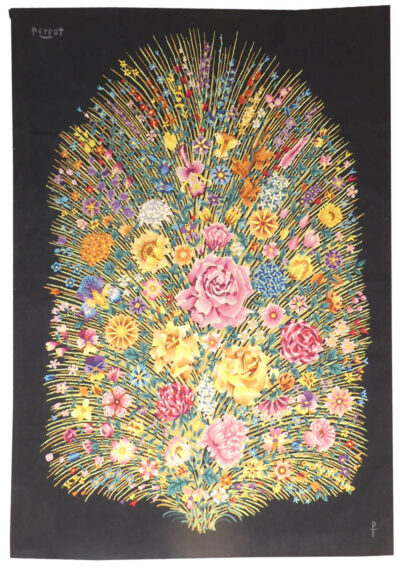
  • Firework bouquet

     
    Aubusson tapestry woven by the Pinton workshop. With its ribbon signed by the artist. Circa 1960.
        First a poster artist, then an artist-ethnographer during the war, Perrot began his work as a painter-cartoonist after the war: he designed nearly 500 cartoons, receiving numerous commissions from the State (with 33 cartoons, Perrot is the 20th-century cartoonist most represented in the Mobilier National collections!), most of which were woven in Aubusson. His eminently decorative and shimmering style is very characteristic: treated in flat colors (without mottling or stippling), a profusion of animals (mostly birds) stands out, without perspective, against a vegetal background, in the style of medieval mille-fleurs tapestries.   Like a floral fireworks display, "Bouquet d'artifice" bursts forth with different varieties, even slightly stylized, in a frenzy of colors accentuated by the black background: an ode to Nature.     Bibliography: Tapestry, drawings, paintings, engravings by René Perrot, Dessein et Tolra, 1982 Exhibition catalog: René Perrot, mon pauvre cœur est un hibou (René Perrot, my poor heart is an owl), Aubusson, Cité Internationale de la Tapisserie, 2023  
  • The Death of the Hare

     
    Aubusson tapestry woven by the Rivière des Borderies workshop. 1946.
     
        Perrot began his work as a cartoonist after the war, producing nearly 500 cartoons, with numerous commissions from the state, most of which were woven in Aubusson. His eminently decorative and shimmering style is very characteristic: a profusion of butterflies or birds, most often, stands out against a vegetal background, in the style of mille-fleurs tapestries (which also inspired Dom Robert).     One of Perrot's oldest tapestries, contemporary with "The Fox Hunt" which appeared in the seminal exhibition of 1946, our design bears witness to Perrot's early inspiration: a love of nature and animals, an interest in botany and geology, and inhabited landscapes (man is absent here, but he lives in the village and is a hunter)... The artist-ethnographer recycled his observations made for the Museum of Popular Arts and Traditions during the war into tapestries.       Bibliography: Tapestry, drawings, paintings, engravings by René Perrot, Dessein et Tolra, 1982, ill. p.83 Exhibition catalog. René Perrot, mon pauvre cœur est un hibou (René Perrot, my poor heart is an owl), Aubusson, Cité de la Tapisserie, 2023
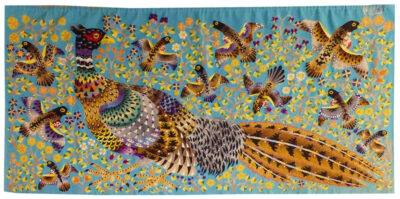
  • Faisan

     
    Tapisserie d’Aubusson tissée par l'atelier Pinton. Avec son bolduc signé. Circa 1960.
          Perrot commence son oeuvre de cartonnier à l’issue de la guerre, réalisant près de 500 cartons, avec de nombreuses commandes de l’Etat, la plupart tissées à Aubusson. Son style éminemment décoratif et chatoyant est très caractéristique :  un foisonnement de papillons ou d’oiseaux, le plus souvent, se détache sur un fond végétal, dans le goût des tapisseries mille-fleurs (dont s’inspirera aussi Dom Robert).   Sujet ornithologique, foisonnement des motifs inspiré des mille-fleurs médiévales, fond uni en aplat (en l’occurrence le fameux « bleu Perrot » comme le nommait les ateliers Pinton, utilisé de façon récurrente) font de notre carton un modèle exemplaire de l’art de Perrot à partir des années 60.   Bibliographie : Tapisserie, dessins, peintures, gravures de René Perrot, Dessein et Tolra, 1982 Cat. Expo. René Perrot, mon pauvre cœur est un hibou, Aubusson, Cité de la Tapisserie, 2023
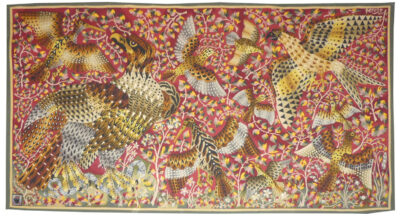
     
  • The turkey


    Aubusson tapestry woven by the Pinton workshop. With its ribbon. Circa 1960.
            Perrot began his work as a cartoonist after the war, producing nearly 500 cartoons, with numerous commissions from the state, most of which were woven in Aubusson. His eminently decorative and shimmering style is very characteristic: a profusion of butterflies or birds, most often, stands out against a vegetal background, in the style of mille-fleurs tapestries (which also inspired Dom Robert).   Our tapestry is a fine example of the artist's bird portraits; the turkey appears, as it often does, alongside other birds, against a background inspired by medieval mille-fleurs. Another example was woven for the Ministry of Reconstruction. Bibliography: Tapestry, drawings, paintings, engravings by René Perrot, Dessein et Tolra, 1982 Tapestry of Aubusson, Association for the Development of the Aubusson Region, 1983, ill. p. 40 Exhibition catalog: René Perrot, mon pauvre cœur est un hibou (My poor heart is an owl), Aubusson, Cité de la Tapisserie, 2023    
     
Go to top