All tapestries

  • The scarlet of day

       
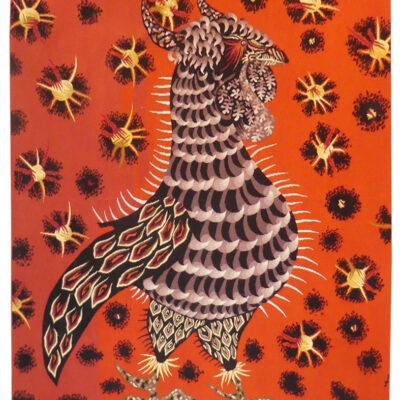
    Aubusson tapestry woven by the Goubely workshop. 1953.
          Lurçat's body of work is immense, but it is his role in the revival of the art of tapestry that has ensured his place in history. He began working with canvas in 1917, then collaborated with Marie Cuttoli in the 1920s and 1930s. His first collaboration with Les Gobelins dates back to 1937, when he discovered the Apocalypse tapestry in Angers, which inspired him to devote himself entirely to tapestry. He first tackled technical issues with François Tabard, then, when he moved to Aubusson during the war, he defined his own system: large stitches, measured tones, numbered cartoons. A huge production then began (more than 1,000 cartoons), amplified by his desire to involve his painter friends, the creation of the A.P.C.T. (Association des Peintres-Cartonniers de Tapisserie) and his collaboration with the La Demeure gallery and Denise Majorel, then by his role as a tireless promoter of the medium throughout the world.   His woven work bears witness to a specifically decorative art of imagery, in a highly personal, cosmogonic symbolic iconography (sun, planets, zodiac, four elements, etc.), stylized plants, animals (goats, roosters, butterflies, chimeras, etc.), stand out against a background without perspective (deliberately distanced from painting), and intended, in his most ambitious cartoons, to share a vision that is both poetic (he sometimes embellishes these tapestries with quotations) and philosophical (the major themes were addressed as early as the war: freedom, resistance, fraternity, truth, etc.) and whose culmination was to be the "Chant du Monde" (Jean Lurçat Museum, former Saint-Jean Hospital, Angers), which remained unfinished at his death.   If there is one motif that runs through Lurçat's work, it is that of the rooster, repeated ad infinitum. Our model (this one truly scarlet) is a larger, inverted echo of "Ecarlate bleu" from 1953.     Bibliography: Tapisseries de Jean Lurçat 1939-1957, Pierre Vorms Editeur, 1957 Claude Roy, Jean Lurçat, Pierre Cailler 1966, reproduced as no. 100 Exhibition catalog: Jean Lurçat, Nice, Musée des Ponchettes, 1968 Cat. Expo. Lurçat, 10 ans après, Musée d’Art moderne de la ville de Paris, 1976 Cat. Expo. Les domaines de Jean Lurçat, Angers, Musée Jean Lurçat et de la tapisserie contemporaine, 1986 Colloquium Jean Lurçat and the renaissance of tapestry in Aubusson, Aubusson, Musée départemental de la Tapisserie, 1992 Exhibition catalog Dialogues avec Lurçat, Musées de Basse-Normandie, 1992 Exhibition catalog Jean Lurçat, Donation Simone Lurçat, Academy of Fine Arts, 2004 Gérard Denizeau, Denise Majorel, a life devoted to tapestry, Aubusson, Departmental Museum of Tapestry Gérard Denizeau, Jean Lurçat, Liénart, 2013 Exhibition catalog Jean Lurçat, Meister der französischen Moderne, Halle, Kunsthalle, 2016 Exhibition catalog. Jean Lurçat au seul bruit du soleil, Paris, Galerie des Gobelins, 2016 Exhibition catalog. Jean Lurçat, la terre, le feu, l’eau, l’air, Perpignan, Musée d’art Hyacinthe Rigaud, 2024    
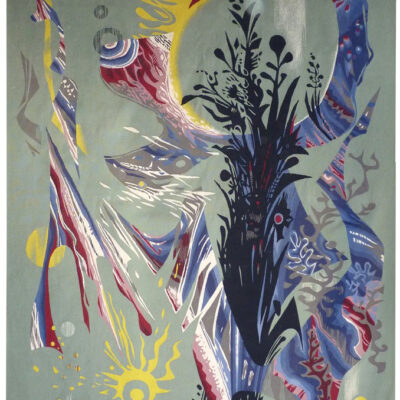
  • Ornaments

     
    Aubusson tapestry woven by the Tabard workshop. With its ribbon signed by the artist, no. 4. 1963. Lurçat approached Saint-Saëns, initially a fresco painter, in 1940. And during the war, Saint-Saëns produced his first allegorical masterpieces, tapestries of indignation, combat, and resistance: "Les Vierges folles" (The Mad Virgins), "Thésée et le Minotaure" (Theseus and the Minotaur). At the end of the war, he naturally joined Lurçat, whose convictions he shared (on numbered cartoons and limited tones, on the specific style required for tapestry, etc.) within the A.P.C.T. (Association des Peintres-cartonniers de Tapisserie). His universe, in which the human figure, stretched and elongated, occupies a considerable place (compared in particular to the place it occupies in the work of his colleagues Lurçat and Picart le Doux), revolves around traditional themes: women, the Commedia dell'arte, Greek myths, etc., sublimated by the brilliance of the colors and the simplification of the layout. He then evolved in the 1960s towards more lyrical, almost abstract cartoons, dominated by cosmic elements and forces. This cartoon is precisely in this vein. To quote the 1987 catalog (p. 37): "Ornaments, a purely decorative tapestry, is similar to Daedalus, Biology (held at the CNRS), and Bel Canto in its ample, fluid, lyrical style, very close to the brush studies in which Saint-Saëns indulged in the joy of freely applied color." Five copies of this cartoon were woven. Bibliography: Cat. Expo. Tapisseries contemporaines haute lisse-basse lisse, 1945-1979, Paris, Mairie annexe du XIXe arrondissement, 1979 (reproduced on p. 29) Exhibition catalog. Saint-Saëns, woven works, Aubusson, Musée départemental de la Tapisserie, 1987 (tapestry featured in the exhibition, but not reproduced in the catalog) Exhibition catalog. Marc Saint-Saëns, tapestries, 1935-1979, Angers, Jean Lurçat and Contemporary Tapestry Museum, 1997-1998 (reproduced on p.22) Exhibition catalog Marc Saint-Saëns, Moulins Gallery, PAD 2010 (reproduced on p.16)    
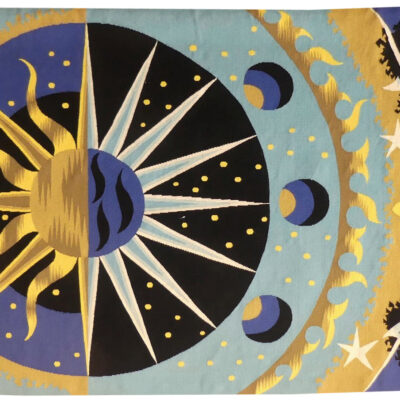
  • The 3 butterflies

        Aubusson tapestry woven by the Picaud workshop. With its ribbon signed by the artist's widow, no. 1/6. Circa 1980.       Jean Picart le Doux was one of the leading figures in the revival of tapestry. He began his career in 1943, creating cartoons for the ocean liner La Marseillaise. Close to Lurçat, whose theories he embraced (limited tones, numbered cartoons, etc.), he was a founding member of the A.P.C.T. (Association des Peintres-cartonniers de Tapisserie) and soon became a professor at the Ecole Nationale Supérieure des Arts Décoratifs. The state commissioned him to produce numerous cartoons, most of which were woven in Aubusson, and some at Les Gobelins: the most spectacular were for the University of Caen, the Théâtre du Mans, the ocean liner France, and the Prefecture of Creuse. While Picart le Doux's designs were similar to those of Lurçat, so too were his sources of inspiration and themes, but in a more decorative than symbolic register, combining the stars (the sun, moon, stars, etc.), the elements, nature (wheat, vines, fish, birds, etc.), man, texts, etc. While butterflies are a favorite theme of Lurçat's, they are rarer in Picart le Doux's work. Even here, and despite the title, their presence is marginal: the cardboard actually reproduces, in a minor key, "Lumière" (Light) from 1960.     Bibliography: Marthe Belle-Joufray, Jean Picart le Doux, Publications filmées d’art et d’histoire, 1966 Maurice Bruzeau, Jean Picart le Doux, Murs de soleil, Editions Cercle d’art, 1972 Cat. Exp. Jean Picart le Doux, tapestries, Musée de Saint-Denis, 1976 Cat. Exp. Jean Picart le Doux, Musée de la Poste, 1980          
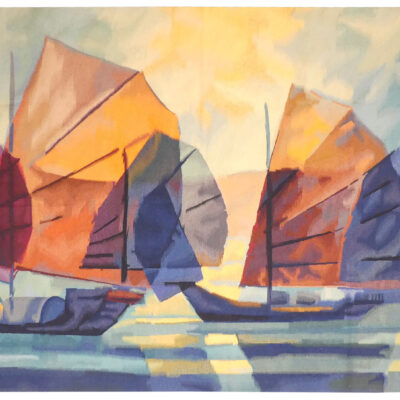
  • Oriental Veils


    Aubusson tapestry woven by the Four workshop. With its ribbon, no. EA. Circa 1980. Toffoli devoted much of his time to tapestry with the Robert Four workshop from 1976 onwards, producing hundreds of cartoons. We find the post-Cubist transparencies characteristic of the painter, as well as his subjects. Indeed, Toffoli's tapestry is not dissimilar to his painting: a painter-traveler, he illustrates in our cartoon the junks he observed during his stays in the Far East.  
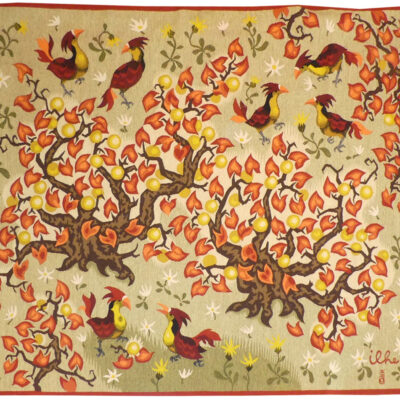
  • The golden fruits

       
    Tapestry woven in Aubusson by the Tabard workshop. With its ribbon signed by the artist. Circa 1965.
       
    Having become a painter and tapestry artist later in life, Henri Ilhe nevertheless produced, from 1964 onwards, a considerable body of woven work (more than 120 tapestries, all woven at Tabard) in a charming style, featuring birds and butterflies flitting among gnarled shrubs.   "Les fruits d'or" (The Golden Fruits) is, in this respect, characteristic of Ilhe's bucolic inspiration.
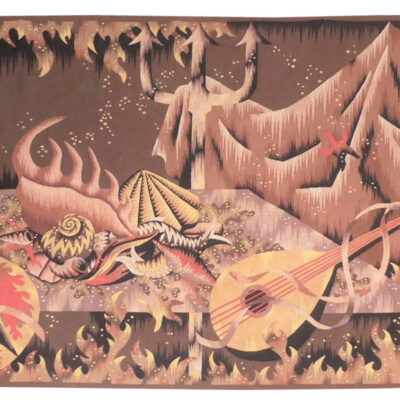
  • Treasure of Amphitrite

      Aubusson tapestry woven by the Berthaut workshop. With its torn ribbon. 1949. Jean Picart le Doux was one of the leading figures in the revival of tapestry. He began working in the field in 1943, creating cartoons for the ocean liner La Marseillaise. Close to Lurçat, whose theories he embraced (limited tones, numbered cartoons, etc.), he was a founding member of the A.P.C.T. (Association des Peintres-cartonniers de Tapisserie) and soon became a professor at the Ecole Nationale Supérieure des Arts Décoratifs. The state commissioned him to produce numerous cartoons, most of which were woven in Aubusson, and some at Les Gobelins: the most spectacular were for the University of Caen, the Théâtre du Mans, the ocean liner France, and the Prefecture of Creuse. While Picart le Doux's designs were similar to those of Lurçat, so too were his sources of inspiration and themes, but in a more decorative than symbolic register, combining the stars (the sun, moon, and other stars), the elements, nature (wheat, vines, fish, birds, etc.), man, texts, etc. A synthesis (from 1949!) between the sea and music, omnipresent themes in the artist's work, in an unusual color palette. The theme of underwater treasure will be taken up more literally by Perrot, in "Trésors enfouis" (Buried Treasures), for example.   Bibliography: Marthe Belle-Joufray, Jean Picart le Doux, Publications filmées d’art et d’histoire, 1966 Maurice Bruzeau, Jean Picart le Doux, Murs de soleil, Editions Cercle d'art, 1972, no. 18 Cat. Exp. Jean Picart le Doux, tapestries, Musée de Saint-Denis, 1976 Cat. Exp. Jean Picart le Doux, Musée de la Poste, 1980            
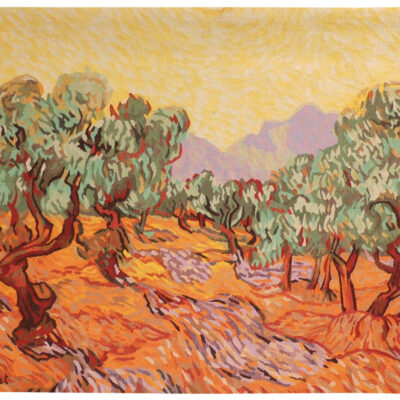
  • Oliviers avec ciel jaune et soleil


    Tapisserie d'Aubusson tissée par l'atelier Four. Avec son bolduc, n°6/6. D'après une oeuvre de l'artiste de 1889, conservée au Minneapolis Institute of Arts.
          La manufacture Four reproduit en tapisserie, tissée à la main, certaines des grandes oeuvres de la peinture : ainsi Klee, Modigliani, Macke ou, ici, van Gogh ont été transcrits en laine, en reproduisant les nuances de matières et de touches des artistes.  
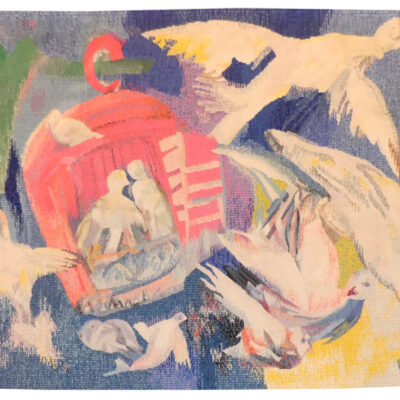
  • The birdcage

       
    Aubusson tapestry woven in the Pinton workshops. With its ribbon, no. 1/6. Circa 1980.
          Although he was a silk designer in his youth and created large-format paintings that served as manifestos at exhibitions (for example, "La peste en Beauce" from 1953 measured 250 x 360 cm), Lorjou's interest in tapestry came late in life: perhaps he considered the harshness and robustness of his style unsuitable for weaving (his close friends, Rebeyrolle, Mottet, Sébire, etc., were never woven themselves). In the 1970s, his style became more dreamlike and less expressionistic: it was then that he provided cartoons for the Pinton workshop.   The color palette and bird motifs are characteristic of Lorjou's work in the 1970s; the texture of the paintings is reproduced in tapestry through differences in weaving techniques.  
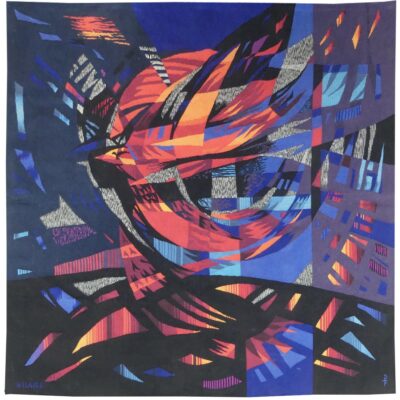
  • The Firebird

     
    Aubusson tapestry woven in the Pinton workshops. With its signed ribbon. 1963.
          Attracted by large surfaces, under the influence of Untersteller at the School of Fine Arts, Hilaire produced numerous murals. Logically, from 1949 onwards, along with many other artists inspired by Lurçat (he joined him in the A.P.C.T., Association des Peintres-Cartonniers de Tapisserie), he produced numerous cartoons (several dozen), some of which were woven in Beauvais or at the Gobelins.   "L'oiseau de feu" (The Firebird) shows a dynamic side that is quite rare in Hilaire's work, which is better known for its depictions of mountains and forests. However, his fractured, kaleidoscopic style lends itself admirably to the expression of movement. Bibliography: Hilaire, woven works, Galerie Verrière, 1970, ill. Exhibition catalog Hilaire, from line to light, Musée Départemental Georges de la Tour, Vic-sur-Seille, 2010.  
Go to top