All tapestries

  • Reflections

     
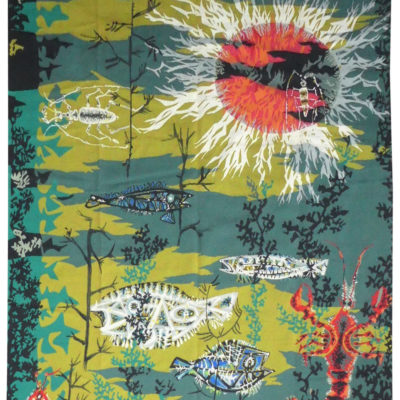
    Aubusson tapestry woven by the Pinton workshop. With its ribbon, no. 6/6. Circa 1960.
        Fumeron created his first cardboard sculptures (he would go on to make more than 500) in the 1940s, collaborating with the Pinton workshops, then receiving numerous commissions from the government, before participating in the decoration of the ocean liner "France." Initially figurative and influenced by Lurçat, he evolved towards abstraction, before returning to colorful and realistic figuration in the 1980s. Under the red sun, fish, insects, and lobsters frolic in a dreamlike composition typical of the artist: many of these motifs can be found, for example, in "Avant l'homme" (Before Man), woven by Les Gobelins (see Cat. Expo. "Le Mobilier National et les Manufactures Nationales des Gobelins et de Beauvais sous la IVe République" (The National Furniture and the National Manufactories of Les Gobelins and Beauvais under the Fourth Republic), Beauvais, 1997).
  • Birds and clusters

     
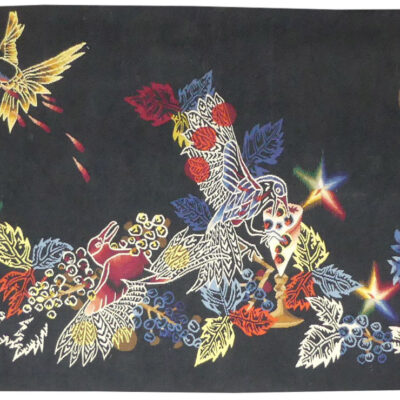
    Aubusson tapestry woven by the Pinton workshop. With its ribbon. Circa 1950.
        Lurçat's body of work is immense, but it is his role in the revival of the art of tapestry that has ensured his place in history. He began working with canvas in 1917, then collaborated with Marie Cuttoli in the 1920s and 1930s. His first collaboration with Les Gobelins dates back to 1937, when he discovered the Apocalypse tapestry in Angers, which inspired him to devote himself entirely to tapestry. He first tackled the technical issues with François Tabard, then, when he moved to Aubusson during the war, he defined his own system: large stitches, counted tones, numbered cartoons. A huge production then began (more than 1,000 cartoons), amplified by his desire to involve his painter friends, the creation of the A.P.C.T. (Association des Peintres-Cartonniers de Tapisserie) and his collaboration with the La Demeure gallery and Denise Majorel, then by his role as a tireless promoter of the medium throughout the world. His woven work bears witness to a specifically decorative art of imagery, in a highly personal, cosmogonic symbolic iconography (sun, planets, zodiac, four elements, etc.), stylized plants, animals (goats, roosters, butterflies, chimeras, etc.), stand out against a background without perspective (deliberately distanced from painting) and, in his most ambitious cartoons, are intended to share a vision that is both poetic (he sometimes embellishes these tapestries with quotations) and philosophical (the major themes were addressed from the war onwards: freedom, resistance, fraternity, truth, etc.) and which culminated in the "Chant du Monde" (Jean Lurçat Museum, former Saint-Jean Hospital, Angers), unfinished at the time of his death.   The motifs are always the same: vines, bunches of grapes, and glasses usually appear on the artist's tables, while birds usually accompany fish. There are fewer symbols here, as evidenced by the purely descriptive title, which evokes the hardships endured by winegrowers.     Bibliography: Tapisseries de Jean Lurçat 1939-1957, Pierre Vorms Editeur, 1957 Exhibition catalog: Lurçat, 10 ans après, Musée d'Art moderne de la ville de Paris, 1976 Cat. Expo. Les domaines de Jean Lurçat, Angers, Musée Jean Lurçat et de la tapisserie contemporaine, 1986 Colloque Jean Lurçat et la renaissance de la tapisserie à Aubusson, Aubusson, Musée départemental de la Tapisserie, 1992 Exhibition catalog. Dialogues avec Lurçat, Museums of Lower Normandy, 1992 Exhibition catalog. Jean Lurçat, Donation Simone Lurçat, Academy of Fine Arts, 2004 Gérard Denizeau, Jean Lurçat, Liénart, 2013 Exhibition catalog: Jean Lurçat, Meister der französischen Moderne, Halle, Kunsthalle, 2016 Exhibition catalog: Jean Lurçat au seul bruit du soleil, Paris, Galerie des Gobelins, 2016  
  • Rooster

     
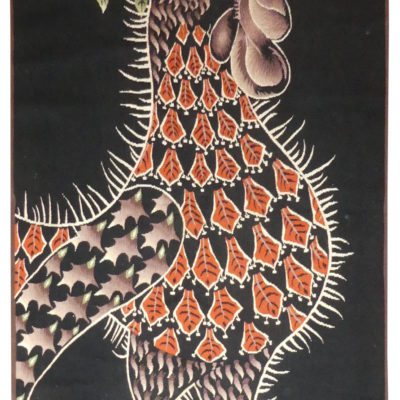
    Aubusson tapestry woven by the Goubely workshop. With its faded ribbon trim. Circa 1950.
        Lurçat's body of work is immense, but it is his role in the revival of the art of tapestry that has ensured his place in history. He began working with canvas in 1917, then collaborated with Marie Cuttoli in the 1920s and 1930s. His first collaboration with Les Gobelins dates back to 1937, when he discovered the Apocalypse tapestry in Angers, which inspired him to devote himself entirely to tapestry. He first tackled the technical issues with François Tabard, then, when he moved to Aubusson during the war, he defined his own system: large stitches, counted tones, numbered cartoons. A huge production then began (more than 1,000 cartoons), amplified by his desire to involve his painter friends, the creation of the A.P.C.T. (Association des Peintres-Cartonniers de Tapisserie) and his collaboration with the La Demeure gallery and Denise Majorel, then by his role as a tireless promoter of the medium throughout the world. His woven work bears witness to a specifically decorative art of imagery, in a highly personal, cosmogonic symbolic iconography (sun, planets, zodiac, four elements, etc.), stylized plants, animals (goats, roosters, butterflies, chimeras, etc.), stand out against a background without perspective (deliberately distanced from painting) and, in his most ambitious cartoons, are intended to share a vision that is both poetic (he sometimes embellishes these tapestries with quotations) and philosophical (the major themes were addressed from the war onwards: freedom, resistance, fraternity, truth, etc.) and which culminated in the "Chant du Monde" (Jean Lurçat Museum, former Saint-Jean Hospital, Angers), unfinished at the time of his death. The rooster, in various forms, with different attributes, playing different roles, is the central figure in Lurçat's bestiary, a kind of stylistic figure repeated ad infinitum: the singularity here comes from the crown of ivy and the feather-leaves, examples of the animal-plant syntheses characteristic of the artist.   Bibliography: Exhibition catalog. La tapisserie française, Musée d'art moderne, Paris, 1946 Tapisseries de Jean Lurçat 1939-1957, Pierre Vorms Editeur, 1957 Exhibition catalog. Jean Lurçat, tapisseries de la fondation Rothmans, Musée de Metz, 1969 Exhibition catalog: Lurçat, 10 ans après, Musée d'Art moderne de la ville de Paris, 1976 Exhibition catalog: Les domaines de Jean Lurçat, Angers, Musée Jean Lurçat et de la tapisserie contemporaine, 1986 Symposium Jean Lurçat et la renaissance de la tapisserie à Aubusson, Aubusson, Departmental Tapestry Museum, 1992 Exhibition catalog. Dialogues avec Lurçat, Museums of Lower Normandy, 1992 Exhibition catalog. Jean Lurçat, Donation Simone Lurçat, Academy of Fine Arts, 2004 Gérard Denizeau, Jean Lurçat, Liénart, 2013 Exhibition catalog. Jean Lurçat, Meister der französischen Moderne, Halle, Kunsthalle, 2016 Exhibition catalog. Jean Lurçat au seul bruit du soleil, Paris, Galerie des Gobelins, 2016
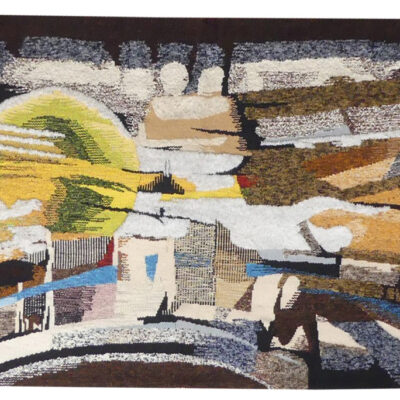
  • The dazzled eye

     
    Tapestry woven by the Clochard workshop. With its ribbon signed by the artist, no. 1/6. Circa 1980.
     
    Trained as an engraver (winner of the Prix de Rome for intaglio engraving in 1942), Jean Louis Viard produced his first cartoons in the mid-1950s. Initially figurative (he was working with Picart Le Doux at the time), he then followed the natural path of many painters and cartoonists (such as Matégot, Tourlière, and Prassinos) by moving towards abstraction. He produced dozens of cartoons until the 2000s, alongside his work as a painter and engraver, but showing a particular interest in materials and textures, following the example of the proponents of the "Nouvelle Tapisserie" movement, of which Pierre Daquin, who wove his work, was one of the major protagonists.   His themes, sometimes metaphysical ("Memories," "Destinies," etc.) range widely, from astronomical infinity ("Solar Darkness") to the miniscule cellular ("Vegetable Mutation"): a profuse and varied body of work, regularly exhibited at La Demeure, in various salons and special exhibitions, and more significantly at the Comparaison salon, where he was responsible for the Tapestry section.
  • The Odyssey

     
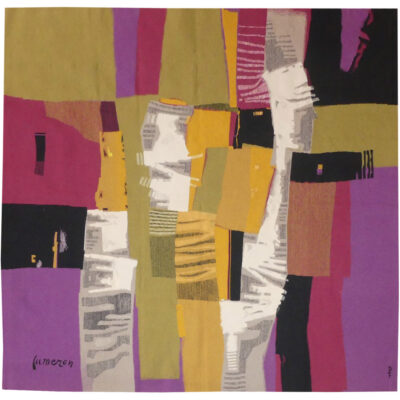
    Aubusson tapestry woven in the Pinton workshops. With its signed ribbon, no. 1/6. Circa 1965.
        Fumeron created his first cardboard designs (he would go on to produce more than 500) in the 1940s, collaborating with the Pinton workshops, then receiving numerous commissions from the government, before participating in the decoration of the ocean liner "France." Initially figurative and influenced by Lurçat, he evolved towards abstraction, before returning to colorful and realistic figuration in the 1980s.   In the 1960s, Fumeron, like some of his peers (Matégot, Wogensky, etc.), moved towards abstraction. His compositions were sometimes inspired by great texts (e.g., "Hamlet") translated into a kaleidoscope of very personal colors.  
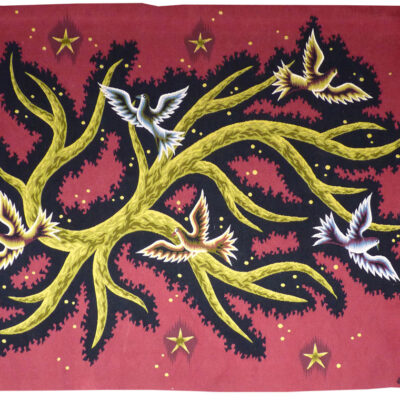
  • The branch

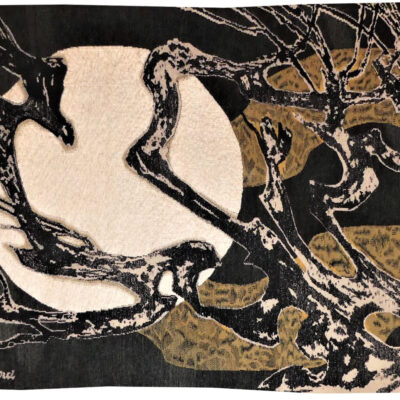
      Aubusson tapestry woven by the Hamot workshop. With its signed ribbon, no. 1. 1961. Jean Picart le Doux is one of the leading figures in the revival of tapestry. He began working in this field in 1943, creating cartoons for the ocean liner "La Marseillaise." Close to Lurçat, whose theories he embraced (limited tones, numbered cartoons, etc.), he was a founding member of the A.P.C.T. (Association des Peintres-cartonniers de Tapisserie) and soon became a professor at the Ecole Nationale Supérieure des Arts Décoratifs. The state commissioned him to produce numerous cartoons, most of which were woven in Aubusson, and some at Les Gobelins: the most spectacular were for the University of Caen, the Théâtre du Mans, the ocean liner France, and the Prefecture of Creuse. While Picart le Doux's designs were similar to those of Lurçat, so too were his sources of inspiration and themes, but in a more decorative than symbolic register, combining the stars (the sun, moon, stars, etc.), the elements, nature (wheat, vines, fish, birds, etc.), man, texts, etc. Cardboard (Bruzeau no. 111) typical of the artist, mixing the animal and plant kingdoms. The realistic treatment of the wood bark contrasts sharply with the graphic and dreamlike aspect of the composition. Bibliography: Maurice Bruzeau, Jean Picart le Doux, Murs de soleil, Editions Cercle d'art, 1972 Cat. Exp. Jean Picart le Doux, Musée de la Poste, 1980  
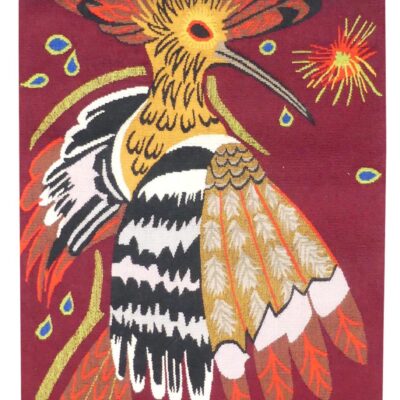
  • The red hoopoe

     
    Aubusson tapestry woven by the Picaud workshop. With its ribbon signed by the artist, no. 3/6. Circa 1970.
     
     
    Originally from Limousin (and daughter of master glassmaker François Chigot), Delphine Bureau-Chigot devoted a significant part of her creative energy (she was also a painter and pastel artist) to producing tapestry cartoons (over a hundred), most of which were woven by the Picaud workshop. These cartoons were often dreamlike in inspiration, with animals (particularly birds) playing an important role.
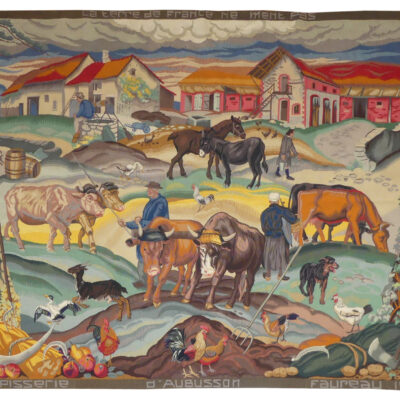
  • The land of France does not lie

     
    Aubusson tapestry. 1943.
        François Faureau's career path is quite unique. Born in Aubusson, he studied at ENAD, then under the direction of Marius Martin, who was already promoting the thick weaving and limited color palette that Lurçat would later adopt. He participated in the ENAD stand at the 1925 International Exhibition of Decorative Arts as a painter and cartoonist with the tapestry "Solitude, verdure" and the screen "Canards," which oscillate between a classicizing style and the influence of Cubism. He later had his own workshop, but his work remained little known and distant from the protagonists of the "Tapestry Renaissance."   Although the Aubusson workshops (like the Manufactures Nationales) continued to operate during the occupation, the woven creations subject to the injunctions of Art-Maréchal remained rare, even though this traditional craftsmanship was in line with the values of the National Revolution. The famous phrase uttered on June 25, 1940, by Pétain (written by Emmanuel Berl), which became a Vichy leitmotif, extolling rural life, deep roots, and, more prosaically, agriculture, is illustrated here in a literal and synthetic way: a variety of work, vegetation, architecture, and animals, ... flourishing under the aegis of the Vichy regime.
  • City

     
    Aubusson tapestry woven in the Four workshop. With its ribbon signed by the artist, n°EA. Circa 1970.
     
    A former student at ENAD in Aubusson, Lartigaud designed his first tapestry in 1968. Since then, he has created hundreds more, most of which have been woven by Manufacture Four, in an abstract style sometimes embellished with stars.
Go to top