-
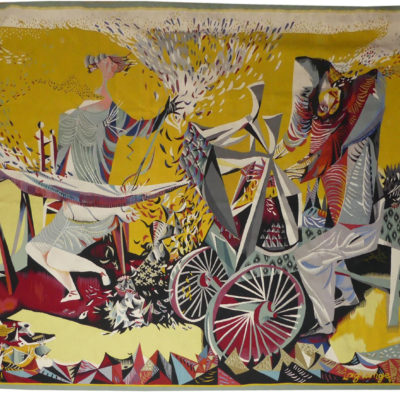
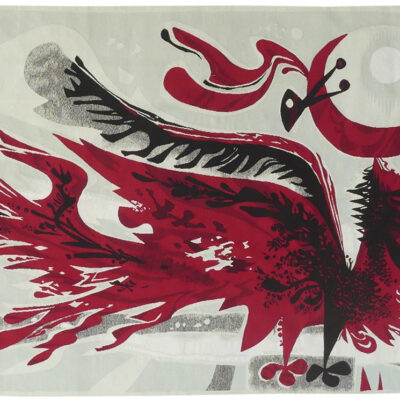
Suburbs Aubusson tapestry woven in the Goubely workshop. With his signature ribbon. 1945. Initially expressionist (like Matégot and Tourlière), his cartoons (from his collaboration with Pierre Baudouin) evolved towards a stylization that would culminate in the 1970s in cartoons made up of refined signs in pure tones. In addition to his role in the revival of tapestry (and related public commissions), Lagrange was a professor at the Ecole Nationale des Beaux-Arts, a regular collaborator with Jacques Tati, a designer of monumental sets, and a renowned painter, close to Estève and Lapicque. "Banlieue," my first tapestry woven in Aubusson, depicts the spectacle of mattress carders scattering wool in the streets with a curious machine," explains the artist. In his early days, Lagrange approached themes such as the suburbs, trades (an amusing mise en abyme on wool working), and everyday life (see Guignebert's contemporary "Le Marché aux Puces") in a realistic, even expressionist vein, which was the antithesis of Lurçat's cosmogony. The tapestry was featured in the 1946 exhibition, and two copies are preserved in public collections, at the Musée de la-Chaux-de-Fonds and the Musée du Pays d'Ussel. Bibliography: Collective, Muraille et laine, Editions Pierre Tisné, 1946, ill. no. 58 Madeleine Jarry, La tapisserie, art du XXe siècle, Office du livre, 1974, ill. no. 69 Cat. Exp. Lagrange, Angers, Musée Jean Lurçat et de la tapisserie contemporaine, 1987, reproduced on pp. 16-17 Cat. Exp. Jean Lurçat, compagnons de route et passants considérables, Felletin, Eglise du château, 1992, reproduced on p.29 Robert Guinot, Jacques Lagrange, les couleurs de la vie, Lucien Souny editeur, 2005, no. 28, reproduced Gérard Denizeau, Denise Majorel, une vie pour la tapisserie, Aubusson, Musée départemental de la tapisserie, reproduced on p.73 J.J. and B. Wattel, Jacques Lagrange ets es toiles : peintures, tapisseries, cinéma, Editions Louvre Victoire, 2020, reproduced on p.33, 70-71
-
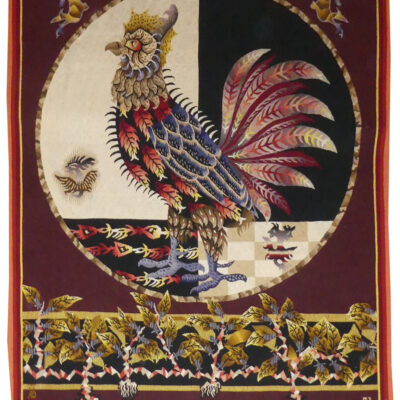
Lurçat's body of work is immense, but it is his role in the revival of the art of tapestry that has ensured his place in history. He began working with canvas in 1917, then collaborated with Marie Cuttoli in the 1920s and 1930s. His first collaboration with Les Gobelins dates back to 1937, when he discovered the Apocalypse tapestry in Angers, which inspired him to devote himself entirely to tapestry. He first tackled the technical issues with François Tabard, then, when he moved to Aubusson during the war, he defined his own system: large stitches, counted tones, numbered cartoons. A huge production then began (more than 1,000 cartoons), amplified by his desire to involve his painter friends, the creation of the A.P.C.T. (Association des Peintres-Cartonniers de Tapisserie) and his collaboration with the La Demeure gallery and Denise Majorel, then by his role as a tireless promoter of the medium throughout the world. His woven work bears witness to a specifically decorative art of imagery, in a highly personal, cosmogonic symbolic iconography (sun, planets, zodiac, four elements, etc.), stylized plants, animals (goats, roosters, butterflies, chimeras, etc.), stand out against a background without perspective (deliberately distanced from painting) and, in his most ambitious cartoons, are intended to share a vision that is both poetic (he sometimes embellishes these tapestries with quotations) and philosophical (the major themes were addressed as early as the war: freedom, resistance, fraternity, truth, etc.) and which culminated in the "Chant du Monde" (Jean Lurçat Museum, former Saint-Jean Hospital, Angers), unfinished at the time of his death. This vertical format with a circular cloisonné motif and burgundy background reappeared sporadically in Lurçat's work in the second half of the 1940s (see "Bosquet," for example). Although the owl motif, to which the title refers, does indeed belong to Lurçat's bestiary, it looks more like a rooster, an unmistakable leitmotif, in a confusion of motifs dear to the artist. Bibliography: Exhibition catalog. La tapisserie française, Musée d'art moderne, Paris, 1946 Tapisseries de Jean Lurçat 1939-1957, Pierre Vorms Editeur, 1957 Exhibition catalog: Jean Lurçat, tapisseries de la fondation Rothmans, Musée de Metz, 1969 Exhibition catalog: Lurçat, 10 ans après, Musée d'Art moderne de la ville de Paris, 1976 Exhibition catalog: Les domaines de Jean Lurçat, Angers, Musée Jean Lurçat et de la tapisserie contemporaine, 1986 Symposium: Jean Lurçat et la renaissance de la tapisserie à Aubusson, Aubusson, Musée départemental de la Tapisserie, 1992 Exhibition catalog. Dialogues avec Lurçat, Museums of Lower Normandy, 1992 Exhibition catalog. Jean Lurçat, Donation Simone Lurçat, Academy of Fine Arts, 2004 Gérard Denizeau, Jean Lurçat, Liénart, 2013 Exhibition catalog: Jean Lurçat, Meister der französischen Moderne, Halle, Kunsthalle, 2016 Exhibition catalog: Jean Lurçat au seul bruit du soleil, Paris, Galerie des Gobelins, 2016Aubusson tapestry woven by the Tabard workshop. With its ribbon. Circa 1945.
-
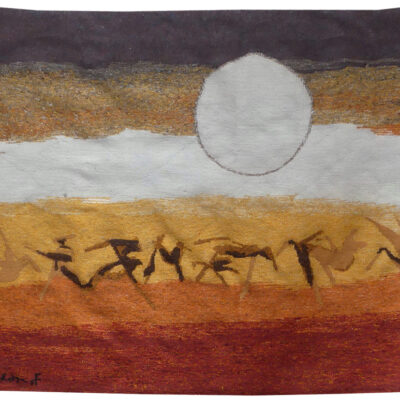
Red Sun
In 1953, Jean Picart le Doux offered Chaye the opportunity to become his assistant and encouraged him to create tapestry cartoons. Chaye went on to produce numerous bucolic cartoons, as well as scenes from Normandy (Mont Saint Michel, Honfleur, regattas, etc.), his native region. This cartoon combines two of Simon Chaye's leitmotifs, the bouquet and the flock of birds, set against a backdrop of red sun. Bibliography: Simon Chaye tapisseries contemporaines, Editions Librairie des musées, 2014, ill. p.120Aubusson tapestry woven in the Legoueix workshop. With its ribbon signed by the artist, no. 1/6. 1989. -
Southern Mail
Aubusson tapestry, published by Jean Laurent. With its ribbon, no. 1/6. 1976.Known for his geometric paintings, sometimes featuring mechanical elements, Gachon, originally from Aubusson, designed several cartoons. Ours is quite different from the artist's usual style. -
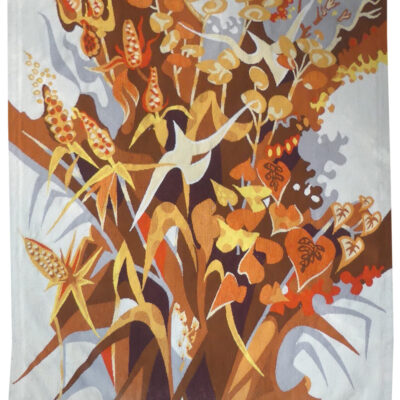
October bouquet
In 1953, Jean Picart le Doux offered Chaye the opportunity to become his assistant and encouraged him to create tapestry cartoons. Chaye went on to produce numerous bucolic cartoons, as well as scenes from Normandy (Mont Saint Michel, Honfleur, regattas, etc.), where he was born. The theme of bouquets is omnipresent in Chaye's work, allowing him to create highly decorative seasonal or chromatic associations in a stylized register. Bibliography: Simon Chaye tapisseries contemporaines, Editions Librairie des musées, 2014, ill. p.77Aubusson tapestry woven in the Legoueix workshop. With its bolduc, no. 5/6. 1974. -
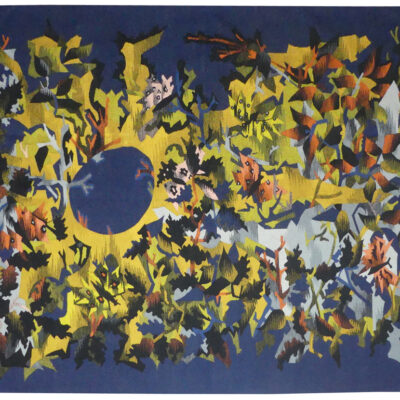
Blue Landscape with Butterflies
Elie Grekoff, who was close to Lurçat's aesthetic, produced more than 300 cartoons: ours bears witness to the artist's evolution from the 1960s onwards, with the disappearance of human or animal figures. The theme of the star (sun, moon) hidden behind foliage then became a recurring motif.Tapestry woven by the ATA (Atelier de Tapisserie d'Angers) With its signed ribbon, no. 1/4. Circa 1970. -
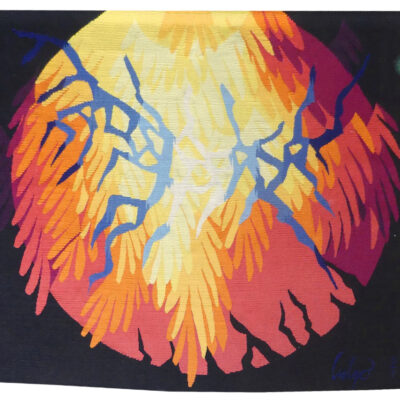
Sunshine for Maria Pia
Aubusson tapestry woven by the Pinton frères workshops. With its bolduc ribbon, no. 1/3. Circa 1970. Holger studied at the National School of Decorative Arts in Aubusson and worked with Lurçat before the latter's death in 1966. He produced numerous dreamlike cartoons woven in Aubusson. Now based in the United States, he remains a tireless advocate and witness of modern tapestry, organizing exhibitions and conferences on the subject. -
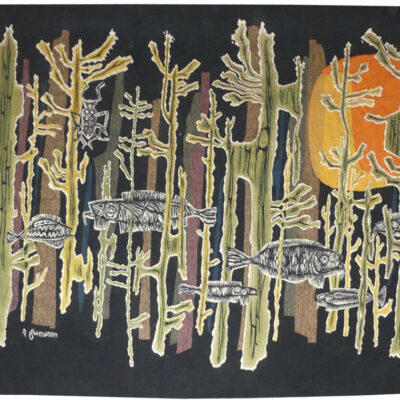
Coral sun
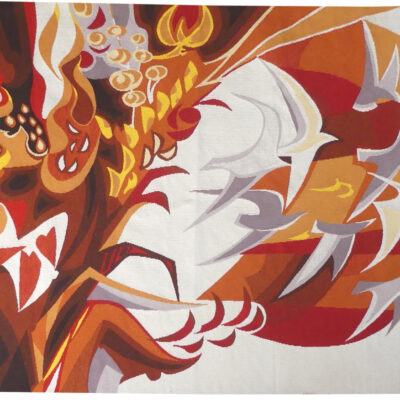
Fumeron created his first cardboard sculptures (he would go on to make more than 500) in the 1940s, collaborating with the Pinton workshops, then receiving numerous commissions from the government, before participating in the decoration of the ocean liner "France." Initially figurative and influenced by Lurçat, he evolved towards abstraction, before returning to colorful and realistic figuration in the 1980s. A vertical pattern of branches in which fish swim, hiding a glowing sun: all of Fumeron's imagination is brought together in this typical cardboard.Aubusson tapestry woven by the Pinton workshop. With its ribbon signed by the artist. Circa 1960. -
beautiful singing
Aubusson tapestry woven by the Tabard workshop. No. 4. 1964.Lurçat approached Saint-Saëns, initially a fresco painter, in 1940. And during the war, Saint-Saëns produced his first allegorical masterpieces, tapestries depicting indignation, combat, and resistance: "Les Vierges folles" (The Mad Virgins) and "Thésée et le Minotaure" (Theseus and the Minotaur). At the end of the war, he naturally joined Lurçat, whose convictions he shared (on numbered cartoons and limited tones, on the specific style required for tapestry, etc.) within the A.P.C.T. (Association des Peintres-cartonniers de Tapisserie). His universe, in which the human figure, stretched and elongated, occupies a considerable place (compared in particular to the place it occupies in the work of his colleagues Lurçat and Picart le Doux), revolves around traditional themes: women, the Commedia dell'arte, Greek myths, etc., sublimated by the brilliance of the colors and the simplification of the layout. He then evolved in the 1960s towards more lyrical, almost abstract cartoons, dominated by cosmic elements and forces. While music is a constant in Saint-Saëns' work, his stylistic evolution in the 1960s towards a more informal, biomorphic art affected his treatment of the subject; but isn't such lyricism ideally suited to the expression of "Bel Canto"? Bibliography: Exhibition catalog. La tapisserie française du Moyen-âge à nos jours (French Tapestry from the Middle Ages to the Present Day), Paris, Musée d'art moderne, 1946. Exhibition catalog. Saint-Saëns, Paris, Galerie La Demeure, 1970, ill. Exhibition catalog. Saint-Saëns, oeuvre tissé (Saint-Saëns, Woven Works), Aubusson, Musée départemental de la Tapisserie, 1987. Exhibition catalog: Marc Saint-Saëns, Tapestries, 1935–1979, Angers, Musée Jean Lurçat et de la Tapisserie Contemporaine, 1997–1998