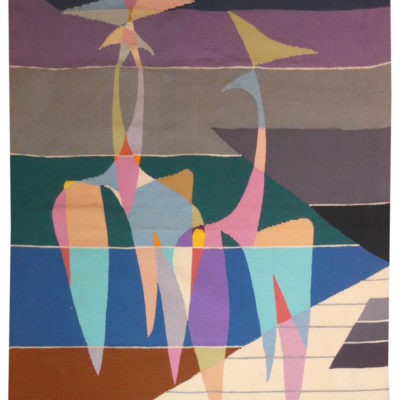
Aubusson tapestry woven by the Glaudin-Brivet workshop.
With its ribbon signed by the artist, no. EX.
1945.
Lurçat approached Saint-Saëns, initially a fresco painter, in 1940. And during the war, Saint-Saëns produced his first allegorical masterpieces, tapestries depicting indignation, combat, and resistance: "Les Vierges folles" (The Mad Virgins) and "Thésée et le Minotaure" (Theseus and the Minotaur). At the end of the war, he naturally joined Lurçat, whose convictions he shared (on numbered cartoons and limited tones, on the specific style required for tapestry, etc.) within the A.P.C.T. (Association des Peintres-cartonniers de Tapisserie). His universe, in which the human figure, stretched and elongated, occupies a considerable place (compared in particular to the place it occupies in the work of his colleagues Lurçat and Picart le Doux), revolves around traditional themes: women, the Commedia dell'arte, Greek myths, etc., sublimated by the brilliance of the colors and the simplification of the layout. He then evolved in the 1960s towards more lyrical, almost abstract cartoons, dominated by cosmic elements and forces.
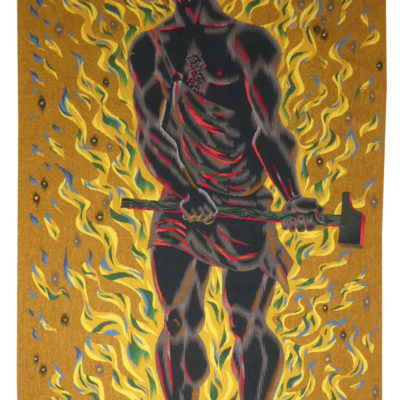
"Fire" is the fourth
e Part of a tapestry depicting the "Four Elements," commissioned by Jansen, woven by Dumontet, and exhibited in 1946 at the Museum of Modern Art. The artist frequently used myths and allegories at the time: "Orion," "Diane," and "Theseus and the Minotaur" are contemporaneous. Here, the muscular figure of a blacksmith-Vulcan, glowing like embers and radiating against a background of flames, leaves an unforgettable impression.
Bibliography:
Exhibition catalog. French Tapestry from the Middle Ages to the Present Day, Paris, Museum of Modern Art, 1946.
Exhibition catalog. Saint-Saëns, Paris, La Demeure Gallery, 1970, ill.
Exhibition catalog. Saint-Saëns, woven works, Aubusson, Musée départemental de la Tapisserie, 1987.
Exhibition catalog. Marc Saint-Saëns, tapestries, 1935-1979, Angers, Musée Jean Lurçat et de la Tapisserie Contemporaine, 1997-1998.