-
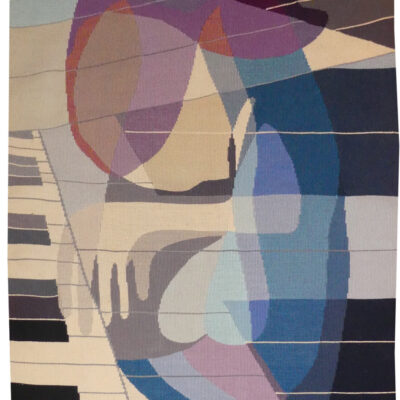
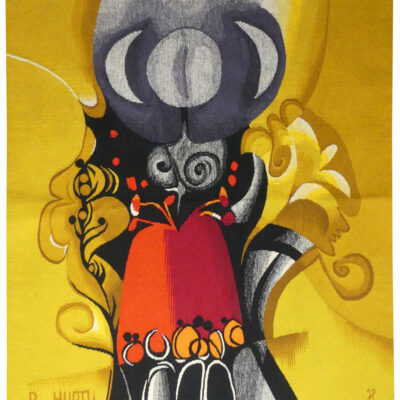
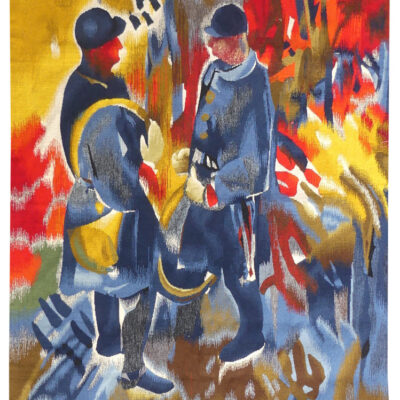
Plus connu pour ses tentures mécaniques proches de l’univers de Picart le Doux, Hurtu a pu concevoir quelques rares cartons plus inspirés, tissés manuellement.
-
Plant world
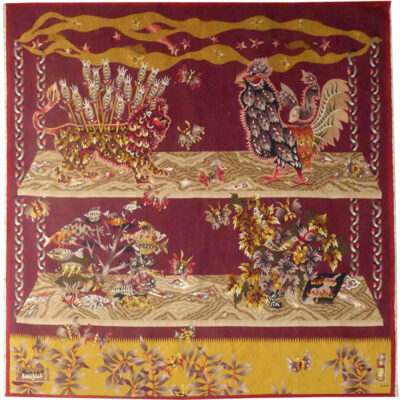
Lurçat's body of work is immense, but it is his role in the revival of the art of tapestry that has ensured his place in history. He began working with canvas in 1917, then collaborated with Marie Cuttoli in the 1920s and 1930s. His first collaboration with Les Gobelins dates back to 1937, when he discovered the Apocalypse tapestry in Angers, which inspired him to devote himself entirely to tapestry. He first tackled the technical issues with François Tabard, then, when he moved to Aubusson during the war, he defined his own system: large stitches, counted tones, numbered cartoons. A huge production then began (more than 1,000 cartoons), amplified by his desire to involve his painter friends, the creation of the A.P.C.T. (Association des Peintres-Cartonniers de Tapisserie) and his collaboration with the La Demeure gallery and Denise Majorel, then by his role as a tireless promoter of the medium throughout the world. His woven work bears witness to a specifically decorative art of imagery, in a highly personal, cosmogonic symbolic iconography (sun, planets, zodiac, four elements, etc.), stylized plants, animals (goats, roosters, butterflies, chimeras, etc.), stand out against a background without perspective (deliberately distanced from painting), and intended, in his most ambitious cartoons, to share a vision that is both poetic (he sometimes embellishes these tapestries with quotations) and philosophical (the major themes are addressed from the war onwards: freedom, resistance, fraternity, truth, etc.) and culminating in the "Chant du Monde" (Jean Lurçat Museum, former Saint-Jean Hospital, Angers), which was unfinished at the time of his death. "Univers végétal" is a paradox: there are more animals than plants. We can already see (as early as 1944) this desire to compartmentalize space, which Lurçat would develop in his cabinets and other bestiaries: stuffed animals, like in a cabinet of curiosities, rest on shelves suspended by chains, under starry skies, in a poetic extension aimed at conveying the Unity of Nature. The tapestry was woven in different formats, as evidenced by the 1946 exhibition: vertical and square (2 x 2 m and 3 x 3 m) for Jansen, a Parisian decorator whose mark appears woven into the tapestry, even though he did not have a workshop in Aubusson (the Dumontet workshop was responsible for his weavings). Bibliography: Exhibition catalog. La tapisserie française, Musée d'art moderne, Paris, 1946, nos. 278-279 Sieben Jahrhunderte Französische Wandteppiche, Wort und Tat, ill. Tapisseries de Jean Lurçat 1939-1957, Pierre Vorms Editeur, 1957, ill. nos. 31, 99 (details) Exhibition catalog. Jean Lurçat, tapisseries de la fondation Rothmans, Musée de Metz, 1969, cat. no. 6 Exhibition catalog. Lurçat, 10 ans après, Musée d’Art moderne de la ville de Paris, 1976 Exhibition catalog. Les domaines de Jean Lurçat, Angers, Musée Jean Lurçat et de la tapisserie contemporaine, 1986 Symposium Jean Lurçat et la renaissance de la tapisserie à Aubusson, Aubusson, Musée départemental de la Tapisserie, 1992 Exhibition catalog. Dialogues avec Lurçat, Museums of Lower Normandy, 1992 Exhibition catalog. Jean Lurçat, Donation Simone Lurçat, Academy of Fine Arts, 2004 Gérard Denizeau, Jean Lurçat, Liénart, 2013 Exhibition catalog: Jean Lurçat, Meister der französischen Moderne, Halle, Kunsthalle, 2016 Exhibition catalog: Jean Lurçat au seul bruit du soleil, Paris, Galerie des Gobelins, 2016Aubusson tapestry woven for Jansen. 1944. -
Pilot bird
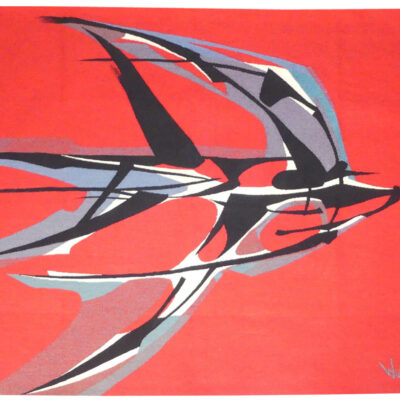
A member of the A.P.C.T. (Association des Peintres-Cartonniers de Tapisserie), Wogensky was one of many artists who devoted themselves to tapestry in the immediate post-war period, following in the footsteps of Lurçat. Initially influenced by Lurçat, Wogensky's work (159 cartoons according to the 1989 exhibition catalog) then evolved in the 1960s towards a lyrical abstraction that was not always fully embraced, from cosmic-astronomical themes to decomposed and moving bird forms, towards more refined and less dense cartoons. Although he always proclaimed himself a painter, the artist's reflection on tapestry is very accomplished: "Creating a wall cartoon... means thinking in terms of a space that no longer belongs to us, in terms of its dimensions and scale, and it also requires a broad gesture that transforms and accentuates our presence." "Oiseau Pilote" (Pilot Bird), in the singular, like the trajectory "chronotissée" (chronotized) in a red azure (see "Oiseaux de Midi" (Birds of Noon) or "Envol" (Takeoff), from the same year) of a form (a force even!) that guides and directs: to be continued, then... Bibliography: Exhibition catalog: Robert Wogensky, l’oeuvre tissé, Aubusson, Musée départemental de la tapisserie, 1989 Exhibition catalog: Robert Wogensky, Angers, Jean Lurçat Museum of Contemporary Tapestry, 1989 Exhibition catalog: Workshop Weavings—Artists' Weavings, Angers, Jean Lurçat Museum of Contemporary Tapestry, 2004Aubusson tapestry woven by the Legoueix workshop. With its ribbon signed by the artist, no. 1/6. 1969. -
Water lilies
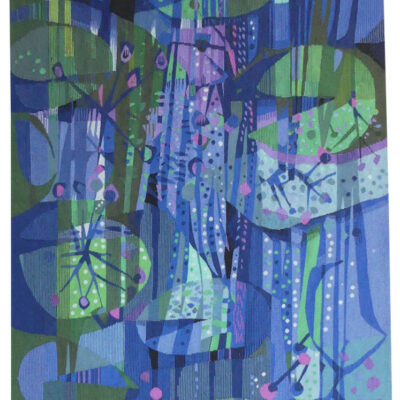
Aubusson tapestry woven in the Pinton workshops for the Verrière gallery. With its bolduc, no. 4/6. 1968.Attracted by large surfaces, under the influence of Untersteller at the School of Fine Arts, Hilaire produced numerous murals. Logically, from 1949 onwards, along with many other artists inspired by Lurçat (he would join him in the A.P.C.T., Association des Peintres-Cartonniers de Tapisserie), he produced numerous cartoons (several dozen), some of which were woven in Beauvais or at the Gobelins. Hilaire appropriated the subject, preempted by Monet, in his usual cubist (and tending towards abstraction) style, made up of lines and circular shapes in an exalted blue and green color palette. His passion for horticulture, to which he had aspired in his youth, echoes that of Monet in Giverny.Bibliography: Exhibition catalog, Hilaire, woven works, Galerie Verrière, 1970, ill. Exhibition catalog, Hilaire, from line to light, Georges de la Tour Departmental Museum in Vic-sur-Seille, 2010. -
Poissons-voile
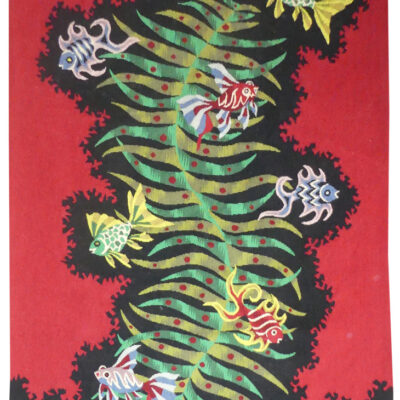
tapisserie d'Aubusson tissée par l'atelier Pinton. Avec son bolduc, signé de l'artiste, n°5/6. 1969. Jean Picart le Doux est l’un des grands animateurs du renouveau de la tapisserie. Ses débuts dans le domaine datent de 1943 : il réalise alors des cartons pour le paquebot “la Marseillaise”. Proche de Lurçat, dont il épouse les théories (tons limités, cartons numérotés,…), il est membre fondateur de l’A.P.C.T.(Association des Peintres-cartonniers de Tapisserie), et bientôt professeur à l’Ecole Nationale Supérieure des Arts Décoratifs. L’Etat lui commande de nombreux cartons tissés pour la plupart à Aubusson, pour certains aux Gobelins : les plus spectaculaires le seront pour l’Université de Caen, le Théâtre du Mans, le Paquebot France ou la Préfecture de la Creuse,…. Si les conceptions de Picart le Doux sont proches de celles de Lurçat, ses sources d’inspiration, ses thématiques, le sont aussi, mais dans un registre plus décoratif que symbolique, où se côtoient les astres (le soleil, la lune, les étoiles…), les éléments, la nature (le blé, la vigne, les poissons, les oiseaux…), l’homme, les textes,…. « Poissons-voile » reprend le motif central de « Rouge de Chine » (Bruzeau n°178), de 1969, aux motifs d’algues, de coraux et de poissons, un classique de l’artiste. Par ailleurs, Picart le Doux est probablement le cartonnier ayant eu le plus souvent recours à des fonds rouges, en différentes nuances. Bibliographie : Marthe Belle-Joufray, Jean Picart le Doux, Publications filmées d’art et d’histoire, 1966 Maurice Bruzeau, Jean Picart le Doux, Murs de soleil, Editions Cercle d’art, 1972 Cat. Exp. Jean Picart le Doux Tapisseries, Musée municipal d’Art et d’Histoire, Saint-Denis, 1976 Cat. Exp. Jean Picart le Doux, Musée de la Poste, 1980 -
Tropiques
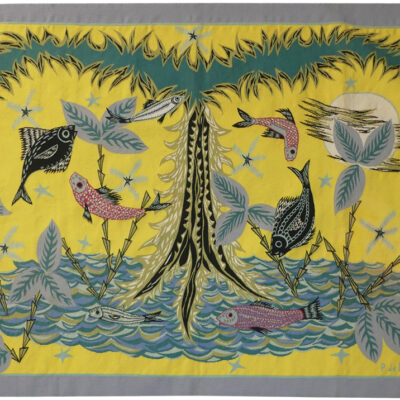
De retour en France dans les années 50, après un long séjour en Argentine, Berroeta donne alors de nombreux cartons dans un style d’abord figuratif (animaux, personnages,…) puis qui se tourne vers l’abstraction, comme dans sa peinture. Influence du cubisme et lyrisme des couleurs cohabitent ici dans un carton qui est peut-être une réminiscence de l’Amérique du Sud.Tapisserie d’Aubusson tissée par l’atelier Pinton. Circa 1955. -
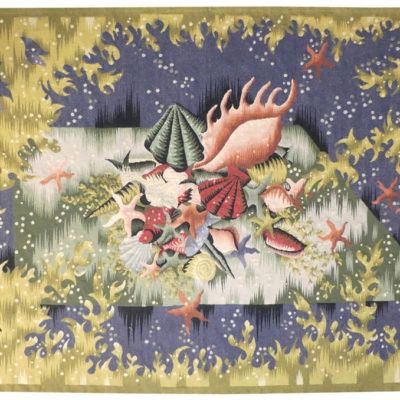
Jean Picart le Doux was one of the leading figures in the revival of tapestry. He began working in this field in 1943, creating cartoons for the ocean liner La Marseillaise. Close to Lurçat, whose theories he embraced (limited tones, numbered cartoons, etc.), he was a founding member of the A.P.C.T. (Association des Peintres-cartonniers de Tapisserie) and soon became a professor at the Ecole Nationale Supérieure des Arts Décoratifs. The state commissioned him to produce numerous cartoons, most of which were woven in Aubusson, and some at Les Gobelins. The most spectacular were for the University of Caen, the Théâtre du Mans, the ocean liner France, and the Prefecture of Creuse. While Picart le Doux's designs were similar to those of Lurçat, so too were his sources of inspiration and themes, but in a more decorative than symbolic register, combining the stars (the sun, moon, stars, etc.), the elements, nature (wheat, vines, fish, birds, etc.), man, texts, etc. Seaweed (and more broadly the underwater world) was a recurring theme for Picart le Doux throughout his career, starting with "Les Algues" in 1946. we can also mention "Spiralgues," "Buisson d'algues," "Les algues vertes," etc. "Les petites algues" is a smaller-scale version of "Les algues," a 260 x 250 cm cardboard cutout published by Leleu. The eponymous seaweed, like a vegetal lace, surrounds a tile covered with shells and starfish, a still life that is the true subject of the cardboard. Bibliography: Marthe Belle-Joufray, Jean Picart le Doux, Publications filmées d’art et d’histoire, 1966 Maurice Bruzeau, Jean Picart le Doux, Murs de soleil, Editions Cercle d'art, 1972 Cat. Exp. Jean Picart le Doux Tapisseries, Musée municipal d'Art et d'Histoire, Saint-Denis, 1976 Cat. Exp. Jean Picart le Doux, Musée de la Poste, 1980
Small algae
Aubusson tapestry woven by the Pinton workshop. With its ribbon. Circa 1950. -
Chasse à courre
Actualisation d’un thème traditionnel de la tapisserie (cf. les chasses de Maximilien entre autres) dans une gamme chromatique automnale. Commere était l’un des nombreux artistes figuratifs « défendus » au Moulin de Vauboyen par Pierre de Tartas.Tapisserie tissée par l’atelier du moulin de Vauboyen. Circa 1970.