-
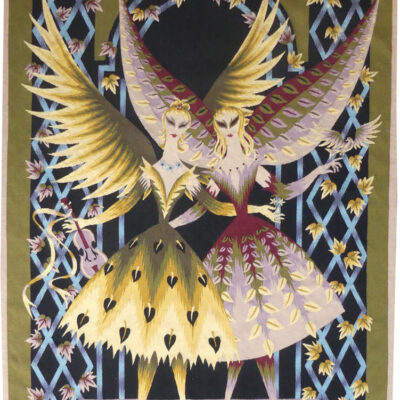
Claude Bleynie discovered tapestry with Jean Picart le Doux in 1952. He then exhibited at the La Demeure gallery (from 1958) and participated in major exhibitions devoted to mural art. His woven work represents more than 300 cartoons, mainly published by the Andraud workshops. Bleynie, in a more abstract vein (which is also sometimes found in tapestry), notably designed cartoons for carpets intended for the luxury "Ile de France" apartment on the ocean liner "France." Also a theater designer, Bleynie created numerous drawings inspired by dance, featuring masked and winged figures in a fairy-tale spirit.Aubusson tapestry woven by the Andraud workshop. Circa 1960.
-
Fire for Law
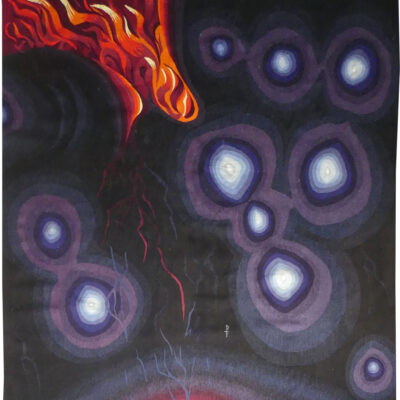
Aubusson tapestry woven by the Pinton frères workshops. With its signed ribbon, no. 1/6. Circa 1970.Holger studied at the National School of Decorative Arts in Aubusson and worked with Lurçat before the latter's death in 1966. He produced numerous dreamlike cartoons woven in Aubusson. Now based in the United States, he remains a tireless advocate and witness of modern tapestry, organizing exhibitions and conferences on the subject. -
Sun
Lurçat approached Saint-Saëns, initially a fresco painter, in 1940. And during the war, Saint-Saëns produced his first allegorical masterpieces, tapestries expressing indignation, combat, and resistance: "Les Vierges folles" (The Mad Virgins) and "Thésée et le Minotaure" (Theseus and the Minotaur). At the end of the war, he naturally joined Lurçat, whose convictions he shared (on numbered cartoons and measured tones, on the specific style required for tapestry, etc.) within the A.P.C.T. (Association des Peintres-cartonniers de Tapisserie, or Association of Tapestry Cartoon Painters). His universe, in which the human figure, stretched and elongated, occupies a considerable place (compared in particular to the place it occupies in the work of his colleagues Lurçat and Picart le Doux), revolves around traditional themes: women, the Commedia dell'arte, Greek myths, etc., sublimated by the brilliance of the colors and the simplification of the layout. He then evolved in the 1960s towards more lyrical, almost abstract cartoons, dominated by cosmic elements and forces. In the 1960s, Saint-Saëns evolved towards a more abstract style with strongly contrasting acid colors, and accentuated his interest in the great phenomena of Nature ("the seasons," "lightning," etc.). Bibliography: Cat. Expo. Saint-Saëns, La Demeure gallery, 1970 Cat. Expo. Saint-Saëns, woven works, Aubusson, Musée départemental de la Tapisserie, 1987 Cat. Expo. Marc Saint-Saëns, tapestries, 1935-1979, Angers, Musée Jean Lurçat et de la Tapisserie Contemporaine, 1997-1998Tapestry woven by the Baudonnet workshop. No. 1/6. Circa 1970. -
The Silver River
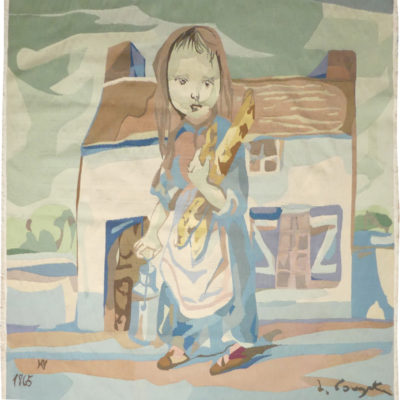
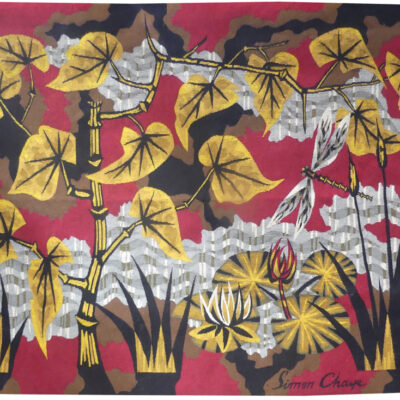
Aubusson tapestry woven in the Hamot workshops based on a cartoon by the artist. With its ribbon signed by the artist. 1965. In 1953, Jean Picart le Doux offered Chaye the opportunity to become his assistant and encouraged him to create tapestry cartoons. Chaye went on to produce numerous bucolic cartoons, as well as views of Normandy (Mont Saint Michel, Honfleur, regattas, etc.), where he was born. A classic cartoon in the naturalist vein of the artist, who specialized in enclosures, hedges, and other riverbanks, animated by animals. Bibliography: Simon Chaye tapisseries contemporaines, Editions Librairie des musées, 2014, ill. p.32 -
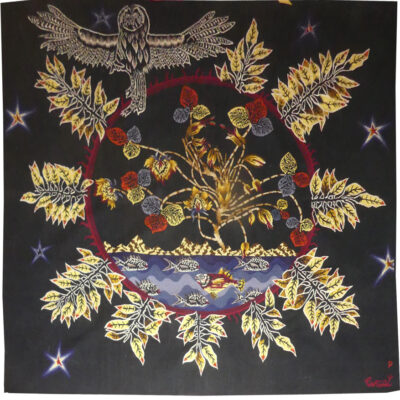
Chile
Lurçat's body of work is immense, but it is his role in the revival of the art of tapestry that has ensured his place in history. He began working with canvas in 1917, then collaborated with Marie Cuttoli in the 1920s and 1930s. His first collaboration with Les Gobelins dates back to 1937, when he discovered the Apocalypse tapestry in Angers, which inspired him to devote himself entirely to tapestry. He first tackled the technical issues with François Tabard, then, when he moved to Aubusson during the war, he defined his own system: large stitches, counted tones, numbered cartoons. A huge production then began (more than 1,000 cartoons), amplified by his desire to involve his painter friends, the creation of the A.P.C.T. (Association des Peintres-Cartonniers de Tapisserie) and his collaboration with the La Demeure gallery and Denise Majorel, then by his role as a tireless promoter of the medium throughout the world. His woven work bears witness to a specifically decorative art of imagery, in a highly personal, cosmogonic symbolic iconography (sun, planets, zodiac, four elements, etc.), stylized plants, animals (goats, roosters, butterflies, chimeras, etc.), stand out against a background without perspective (deliberately distanced from painting) and, in his most ambitious cartoons, are intended to share a vision that is both poetic (he sometimes embellishes these tapestries with quotations) and philosophical (the major themes were addressed as early as the war: freedom, resistance, fraternity, truth, etc.) and whose culmination was to be the "Chant du Monde" (Jean Lurçat Museum, former Saint-Jean Hospital, Angers), unfinished at the time of his death. Once again, the title refers to South America. As for the circular motif accompanied by an owl, it is a classic, see for example "Forêt bleue" (Blue Forest) or "La chouette des figuiers" (The Owl of the Fig Trees),... Bibliography: Tapisseries de Jean Lurçat 1939-1957, Pierre Vorms Editeur, 1957 Cat. Expo. Lurçat, 10 ans après, Musée d'Art moderne de la ville de Paris, 1976 Cat. Expo. Les domaines de Jean Lurçat, Angers, Musée Jean Lurçat et de la tapisserie contemporaine, 1986 Colloque Jean Lurçat et la renaissance de la tapisserie à Aubusson, Aubusson, Departmental Museum of Tapestry, 1992 Exhibition catalog. Dialogues avec Lurçat, Museums of Lower Normandy, 1992 Exhibition catalog. Jean Lurçat, Donation Simone Lurçat, Academy of Fine Arts, 2004 Gérard Denizeau, Jean Lurçat, Liénart, 2013 Exhibition catalog. Jean Lurçat, Meister der französischen Moderne, Halle, Kunsthalle, 2016 Exhibition catalog. Jean Lurçat au seul bruit du soleil, Paris, Galerie des Gobelins, 2016Aubusson tapestry woven by the Pinton workshop. With its ribbon signed by the artist. Circa 1955. -
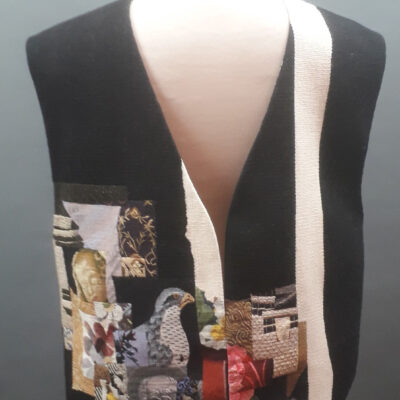
Gilet l'enfant aux mirages
Tapisserie d’Aubusson tissée par l’atelier Legoueix. 1997.Provenance : atelier Sautour-GaillardElève de Wogensky à l'Ecole Nationale Supérieure des Arts Appliqués, Sautour-Gaillard voit son premier carton tissé en 1971 par l'atelier Legoueix (une collaboration qui ne s'est pas démentie par la suite), et il multiplie ensuite les projets monumentaux, dont le plus spectaculaire est "Pour un certain idéal", tenture de 17 tapisseries sur le thème de l'olympisme (conservée au Musée de l'Olympisme de Lausanne). D' abord proche de l'abstraction lyrique, l'artiste réalise dans les années 90 des cartons à base d'assemblages de motifs décoratifs, de textures et de figures, apparemment superposés et comme unifiés dans le tissage. Les 2 gilets de l’exposition « Archéologies » tenue à la galerie Inard en 1997 témoignent de la volonté de la « filière Aubusson », alors en plein désarroi, de varier ses productions : Sautour-Gaillard, grand collectionneurs de tissus lui-même, y montre la même inspiration que dans ses collages tissés contemporains. Bibliographie : D. Cavelier, Jean-René Sautour-Gaillard, la déchirure, Lelivredart, 2013, reproduite p.6 (porté par l’artiste), 296 -
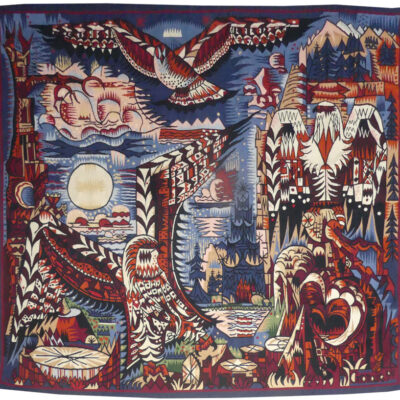
Birds of prey
Aubusson tapestry woven by the Goubely workshop. With its ribbon signed with the stamp and the artist's son, no. 6/6 1941.Gromaire's woven work is modest: 11 cartoons, designed between 1938 and 1944, most of them in Aubusson itself. "His rigorous constructions, his simplifications, his taste for grand composition and fundamental ideas, his skill as a colorist and, to sum it all up, his supreme quality as a master and craftsman, all this made him one of the most accomplished tapestry makers of his time," said Jean Cassou (Cat. Expo. Marcel Gromaire, Paris, Musée National d'art moderne, 1963). It was Guillaume Janneau, head of the Mobilier National, who called on him in 1938, convinced that his style (simplification of forms, geometric designs outlined in black, influence of Cubism, limited palette, etc.) would respond favorably to the new aesthetic problems that tapestry had to solve in order to be reborn (simplified color ranges, synthetic cartoons, etc.): first with a commission on the theme of the four elements, followed by another ("The Seasons"), intended to be executed in Aubusson. In 1940, Gromaire joined Lurçat and Dubreuil there. Working alone, meticulously (many drawings are preparatory to the painted cardboard, and not numbered as in Lurçat's work), in close collaboration with Suzanne Goubely, who would weave all his cartoons, he spent four years in Aubusson, devoting all his creative energy to tapestry. At the end of the war, he left the Creuse region and never made any more cartoons, leaving Lurçat as the great initiator of the tapestry revival. "Birds of Prey" is one of five cartoons designed by Gromaire for the Goubely workshop during the war, and it is emblematic of his style: inspiration from local landscapes, absence of perspective, richly decorative and rigorously ordered appearance, and a limited color palette (it is worth noting the dominant tricolor of the cartoon in occupied France). The atmosphere is also more disturbing than in other tapestries woven at the time.Bibliography: Contemporary Tapestries by Lurçat Gromaire, published by Braun et Cie, 1943, ill. Le Point, Aubusson and the renaissance of tapestry, March 1946, reproduced on p.35 Jean Lurçat, French Tapestry, Bordas, 1947, plate 27 J. Cassou, M. Damain, R. Moutard-Uldry, French Tapestry and Cartoon Painters, Tel, 1957 Cat. Expo., Gromaire, woven work, Aubusson, Tapestry Museum, 1995, reproduced on p.49 Symposium, Jean Lurçat and the Renaissance of Tapestry in Aubusson, Aubusson, Departmental Tapestry Museum, 1992, ill. 14 (detail) Cat. Expo. The Gobelins Manufactory in the First Half of the 20th Century, Beauvais, National Tapestry Gallery, 1999 -
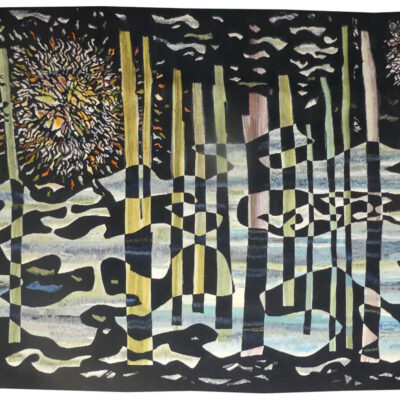
Mirage
Aubusson tapestry woven by the Pinton workshop. With its ribbon. Circa 1965.Fumeron created his first cardboard sculptures (he would go on to make more than 500) in the 1940s, collaborating with the Pinton workshops, then receiving numerous commissions from the government, before participating in the decoration of the ocean liner "France." Initially figurative and influenced by Lurçat, he evolved towards abstraction, before returning to colorful and realistic figuration in the 1980s. An interesting cardboard by Fumeron in his best abstract vein, which here puts him on a par with Matégot.