All tapestries

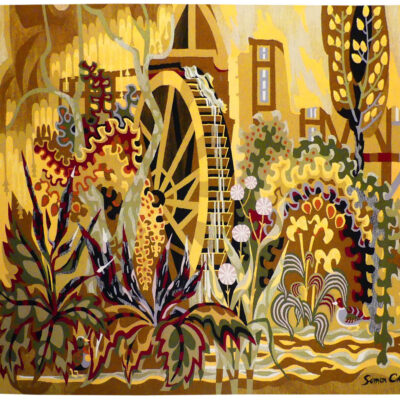
  • Mill

       
    Aubusson tapestry woven by the Glaudin-Brivet workshop. With its bolduc, no. 3/6. Circa 1970.
     
     
      Bibliography: Simon Chaye Contemporary Tapestries, Editions Librairie des musées, 2014, ill. p.40
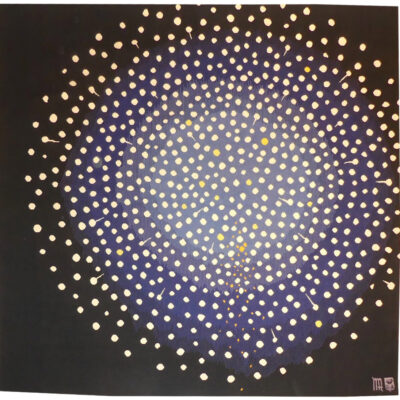
  • Fireworks

       
    Aubusson tapestry woven by the Avignon workshop. 1960.  
      Mark Adams created his first tapestry cartoons in 1952 (a multifaceted artist, he also devoted himself to frescoes, stained glass, etc.). He came to France in 1955, working with Lurçat at Les Tours Saint-Laurent and at the National School of Decorative Arts in Aubusson. One of the few American painters and cartoonists, he participated in the Lausanne Biennials and produced over a hundred cartoons, most of which were woven in Aubusson, notably by Paul Avignon. Best known for his tapestries featuring wing motifs, Mark Adams drew inspiration from a wide variety of sources. Our tapestry is linked to "Fire Fountain," another cartoon that focuses on motifs of light and fireworks sparks against the dark background of a night sky (Collective, Mark Adams, catalogue raisonné of tapestries, Stanford University Press, 2012, no. 033, p. 91).     Bibliography: Collective, Mark Adams, catalogue raisonné of tapestries, Stanford University Press, 2012, no. 033      
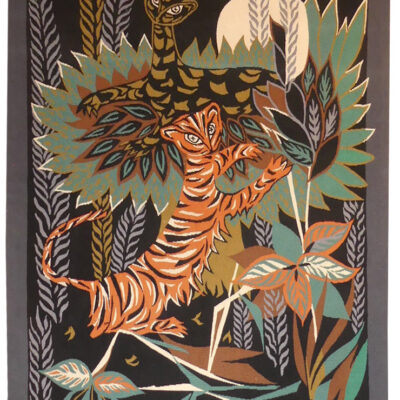
  • Kenya

       
    Tapisserie d’Aubusson tissée par l’atelier Pinton. Avec son bolduc signé. Circa 1960.
          De retour en France dans les années 50, après un long séjour en Argentine, Berroeta donne alors de nombreux cartons dans un style d’abord figuratif (animaux, personnages,…) puis qui se tourne vers l’abstraction, comme dans sa peinture.   L’inspiration exotique est récurrente chez Berroeta, de façon allusive souvent : ni les animaux, ni les plantes ne sont définitivement identifiables, ils ont, ensemble, une visée allégorique.  
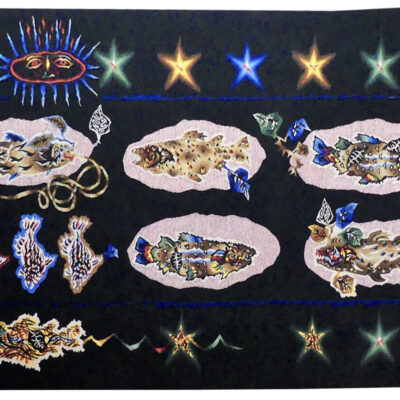
  • Skewer

       
    Aubusson tapestry woven by the Tabard workshop. With its signed bolduc. Circa 1955.
              Lurçat's body of work is immense, but it is his role in the revival of the art of tapestry that has ensured his place in history. He began working with canvas in 1917, then collaborated with Marie Cuttoli in the 1920s and 1930s. His first collaboration with Les Gobelins dates back to 1937, when he discovered the Apocalypse tapestry in Angers, which inspired him to devote himself entirely to tapestry. He first tackled the technical issues with François Tabard, then, when he moved to Aubusson during the war, he defined his own system: large stitches, counted tones, numbered cartoons. A huge production then began (more than 1,000 cartoons), amplified by his desire to involve his painter friends, the creation of the A.P.C.T. (Association des Peintres-Cartonniers de Tapisserie) and his collaboration with the La Demeure gallery and Denise Majorel, then by his role as a tireless promoter of the medium throughout the world.   His woven work bears witness to a specifically decorative art of imagery, in a highly personal, cosmogonic symbolic iconography (sun, planets, zodiac, four elements, etc.), stylized plants, animals (goats, roosters, butterflies, chimeras, etc.), stand out against a background without perspective (deliberately distanced from painting) and, in his most ambitious cartoons, are intended to share a vision that is both poetic (he sometimes embellishes these tapestries with quotations) and philosophical (the major themes were addressed as early as the war: freedom, resistance, fraternity, truth, etc.) and which culminated in the "Chant du Monde" (Jean Lurçat Museum, former Saint-Jean Hospital, Angers), unfinished at the time of his death.     The array is discreet (in some cartoons, Lurçat does not hesitate to stick fish on tridents), and the fish appear as if on a stall, a layout that echoes the compartmentalization of his famous cabinets.     Bibliography: Tapisseries de Jean Lurçat 1939-1957, Pierre Vorms Editeur, 1957 Exhibition catalog: Lurçat, 10 ans après, Musée d'Art moderne de la ville de Paris, 1976 Exhibition catalog: Les domaines de Jean Lurçat, Angers, Musée Jean Lurçat et de la tapisserie contemporaine, 1986 Colloque Jean Lurçat et la renaissance de la tapisserie à Aubusson, Aubusson, Musée départemental de la Tapisserie, 1992 Exhibition catalog Dialogues avec Lurçat, Musées de Basse-Normandie, 1992 Exhibition catalog Jean Lurçat, Simone Lurçat Donation, Academy of Fine Arts, 2004 Gérard Denizeau, Jean Lurçat, Liénart, 2013 Exhibition catalog Jean Lurçat au seul bruit du soleil (Jean Lurçat to the Sound of the Sun Alone), Paris, Galerie des Gobelins, 2016  
  • Of Gold and Shadow

         
    Tapestry woven by the Cartron workshop. With its ribbon signed by the artist, no. 1/1. Circa 1970.
          Initially a sculptor who used a wide variety of materials (steel, concrete, ceramics, etc.), Borderie discovered a passion for tapestry in the 1950s, weaving his first cartoon in 1957. Encouraged by Denise Majorel, he was awarded the Grand Prix National de la Tapisserie in 1962. In 1974, he was appointed director of the Ecole Nationale des Arts Décoratifs d'Aubusson, from which he resigned very quickly. He produced nearly 500 painted cartoons, abstract in form, with simple shapes, graded in a limited range of colors, and woven with large stitches. Here we find the same preoccupations with light (and shadow) as in "Les Armes de la Lumière" (and in Matégot's work). Borderie's work was also woven by other workshops besides Legoueix in Aubusson, including Rado, Daquin, and, more confidentially, Chartron in Angers (which notably wove Jorj Morin's work).     Bibliography: Exhibition catalog André Borderie "pour l'homme simplement" (For Man Alone), Angers, Musée Jean Lurçat et de la Tapisserie Contemporaine, 1998 Exhibition catalog André Borderie et la tapisserie d'Aubusson (André Borderie and Aubusson Tapestry), Aubusson, Manufacture Saint-Jean, 2018
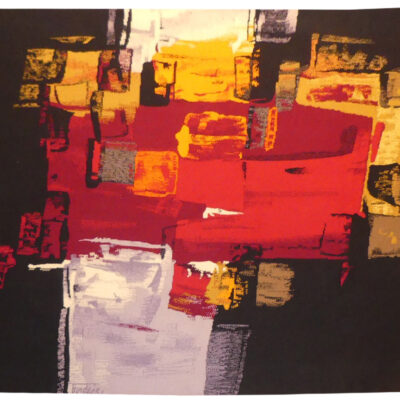
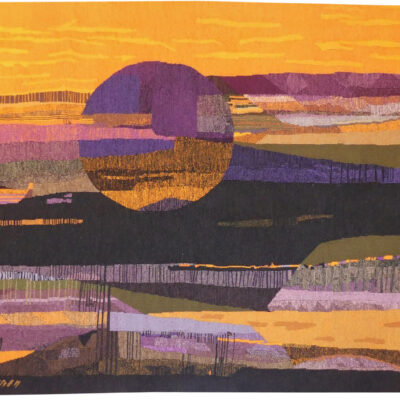
  • Orange composition

       
    Aubusson tapestry woven by the workshop Le mur du nomade. No. 1/6. Circa 1970.
       
    Fumeron created his first cardboard sculptures (he would go on to make more than 500) in the 1940s, collaborating with the Pinton workshops, then receiving numerous commissions from the government, before participating in the decoration of the ocean liner "France." Initially figurative and influenced by Lurçat, he evolved towards abstraction, before returning to colorful and realistic figuration in the 1980s. The setting sun, the orange color palette, and the composition bordering on figuration and abstraction are characteristic of the artist's cartoons from this period.  
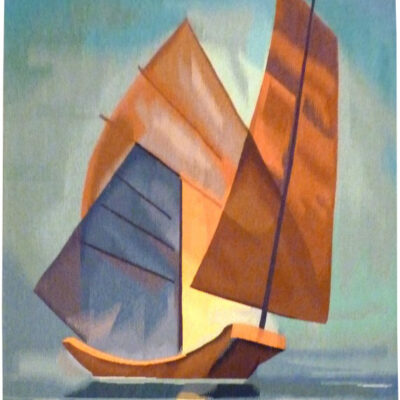
  • Le grand large


    Tapisserie d'Aubusson tissée par l’atelier Four. N°1/6. Circa 1980.  
       
    Toffoli s'est beaucoup consacré à la tapisserie avec la manufacture Robert Four, à partir de 1976, réalisant des centaines de cartons. On  y retrouve  les transparences post-cubistes propres au peintre, ainsi que ses sujets. En effet, la tapisserie de Toffoli ne se démarque pas de sa peinture : peintre-voyageur,  il illustre dans notre carton une jonque observées lors de séjours en Extrême-Orient.
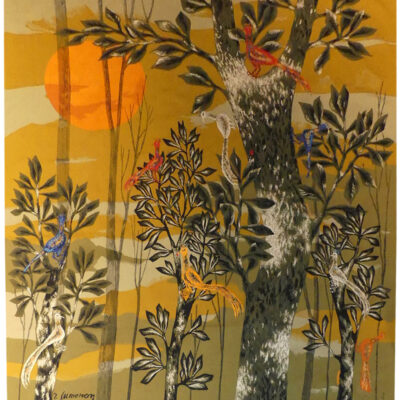
  • Composition aux oiseaux

       
    Tapisserie d’Aubusson tissée par l'atelier Pinton. Avec son bolduc signé. Circa 1960.
          Fumeron réalise ses premiers cartons (il en réalisera plus de 500) dès les années 40, en collaborant avec les ateliers Pinton, puis en recevant de nombreuses commandes de l'Etat, avant de participer à la décoration du paquebot "France". D'abord figuratif, et influencé par Lurçat, il évolue vers l'abstraction, avant de revenir vers une figuration colorée et réaliste à partir des années 80.       Oiseaux perchés sur un arbre  devant un soleil orange, sur un fond kaki : carton caractéristique de la veine décorative et naturaliste de l’artiste (Cf. « ciel de Sienne » par exemple) ; seule l’ampleur du carton singularise notre modèle.  
       
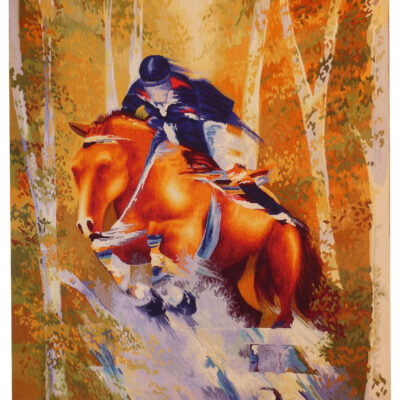
  • Jumping

        Tapisserie d'Aubusson tissée par l'atelier Four. Avec son bolduc signé, n°EA 1/2. Circa 2000.     La Manufacture Four a sollicité différents artistes vivants (au premier rang desquels Toffoli ou Lartigaud) afin de les tisser : une dimension nouvelle est ainsi conférée à la production picturale de Spahn, le peintre du mouvement et des sports.        
Go to top