-
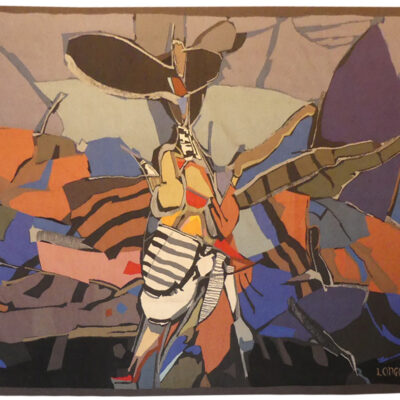
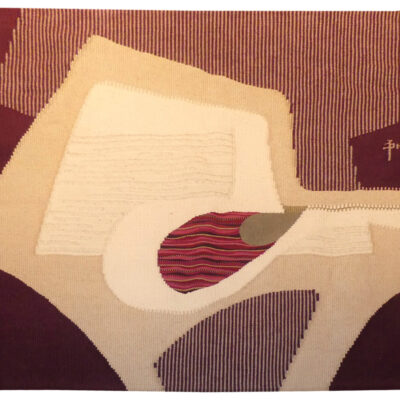
As a young painter who began moving toward abstraction in the late 1940s, Longobardi was commissioned to create large-scale wall decorations in France and abroad (the Presidency of the Republic of Abidjan, the Rectorate of the Academy of Poitiers, etc.), as well as numerous tapestry cartoons, particularly for the Manufactures Nationales, with subjects that were sometimes very modern ("the highway," "the airport," "). At the time, Longobardi was, along with Singier and Springer, one of the very first abstract artists to receive public commissions. Although his work was abstract, his aesthetic evolved over time, from sharp forms to a more lyrical style full of movement, until it became more subdued in the 1960s. The high point of his meteoric official career was the commission for "La Crique" for the private dining room on the starboard side of the ocean liner "France." The artist then became much less visible. Our cartoon is stylistically close to the artist's very last weavings by the Manufactures Nationales, notably "Plein feu" from 1963-1964. Bibliography: Exhibition catalog. Le Mobilier National et les Manufactures Nationales des Gobelins et de Beauvais sous la IVe République, Beauvais, Galerie de la Tapisserie, 1997 Armelle Bouchet-Mazas, Le Paquebot France, Éditions Norma, 2006 Exhibition catalog: Le chic ! Arts décoratifs et mobilier de 1930 à 1960 (Chic! Decorative arts and furniture from 1930 to 1960), Paris, Galerie des Gobelins, 2022-23Aubusson tapestry woven by the Pinton workshop. With its ribbon. Circa 1960.
-
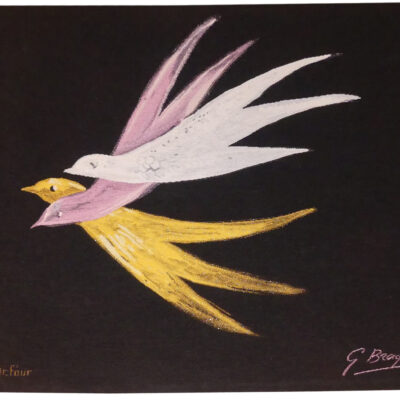
The Three Graces
Aubusson tapestry woven by the Four workshop. No. 3/6. Woven circa 2000, based on a gouache painting from 1962.Braque is one of the great artists of the 20th century who devoted themselves, even modestly, to tapestry. It was initially at the request of Marie Cuttoli, in 1933, that he entrusted works to be reproduced in tapestry (Nature morte au guéridon, on deposit at the Musée des Beaux-Arts in Grenoble). In the 1950s and 1960s, Pierre Baudouin, in collaboration with the weavers of Aubusson and the Manufactures Nationales, was commissioned to produce cartoons based on the artist's works. At the same time, shortly before his death in 1963, Braque produced a final series of gouaches on the theme of metamorphoses, intended to be transcribed into various media. Tapestry was one of them. "Les trois grâces" (The Three Graces), from 1962, is one of these gouaches that would be transposed into sculpture or jewelry. It reflects the lyrical and synthetic style of the artist's later works, which can be seen, for example, in the decoration of the ceiling of the Henri II room in the Louvre Museum, Les Oiseaux (The Birds), 1953. -
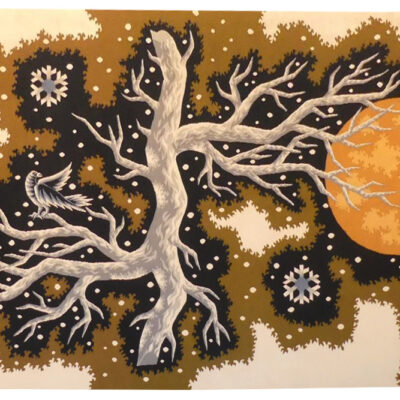
Orange sun
Aubusson tapestry woven by the Berthaut workshop. No. 3/8. 1964. Jean Picart le Doux was one of the leading figures in the revival of tapestry. He began working in the field in 1943, creating cartoons for the ocean liner "La Marseillaise." Close to Lurçat, whose theories he embraced (limited tones, numbered cartoons, etc.), he was a founding member of the A.P.C.T. (Association des Peintres-cartonniers de Tapisserie) and soon became a professor at the Ecole Nationale Supérieure des Arts Décoratifs. The state commissioned him to produce numerous cartoons, most of which were woven in Aubusson, and some at Les Gobelins: the most spectacular were for the University of Caen, the Théâtre du Mans, the ocean liner France, and the Prefecture of Creuse. While Picart le Doux's designs were similar to those of Lurçat, his sources of inspiration and themes were also similar, but in a more decorative than symbolic register, combining the stars (the sun, moon, stars, etc.), the elements, nature (wheat, vines, fish, birds, etc.), man, texts, etc. Our cardboard asymmetrically reproduces "Winter Solstice": the evocation of the seasons, a major theme for the artist, will continue throughout his work. Bibliography: Marthe Belle-Joufray, Jean Picart le Doux, Publications filmées d’art et d’histoire, 1966 Valentine Fougère, Tapisseries de notre temps, Les Éditions du Temps, 1969, ill. p. 84 Maurice Bruzeau, Jean Picart le Doux, Murs de soleil, Editions Cercle d'art, 1972 Cat. Exp. Jean Picart le Doux, tapisseries, Musée de Saint-Denis, 1976 Cat. Exp. Jean Picart le Doux, Musée de la Poste, 1980 -
Melinjana
Settling in Venasque after practicing his art at Les Gobelins, Daniel Drouin designed numerous tapestries woven on high-warp looms. The variety of materials, his taste for abstraction, and the fact that he wove his own designs responded to certain concerns of the "New Tapestry" movement of the time, without going beyond two dimensions, however.Tapestry woven by the Tuilière workshop. With its ribbon. Circa 1970. -
Le pêcheur
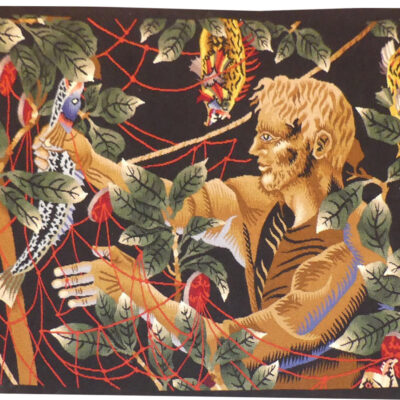
L’Œuvre de Lurçat est immense : c’est toutefois son rôle dans la rénovation de l’art de la tapisserie qui lui vaut d’être passé à la postérité. Dès 1917, il commence par des œuvres au canevas, puis, dans les années 20 et 30, il travaillera avec Marie Cuttoli. Sa première collaboration avec les Gobelins date de 1937, alors qu’il découvre simultanément la tenture de l’Apocalypse d’Angers qui l’incite définitivement à se consacrer à la tapisserie. Il abordera les questions techniques d’abord avec François Tabard, puis à l’occasion de son installation à Aubusson pendant la guerre, il définira son système : gros point, tons comptés, cartons dessinés numérotés. Une production gigantesque commence alors (plus de 1000 cartons), amplifiée par la volonté d‘entraîner ses amis peintres, la création de l’A.P.C.T. (Association des Peintres-Cartonniers de Tapisserie) et la collaboration avec la galerie La Demeure et Denise Majorel, puis par son rôle d’inlassable propagateur du médium à travers le Monde. Son œuvre tissée témoigne d’un art d’imagier spécifiquement décoratif, dans une iconographie symbolique très personnelle, cosmogonique (soleil, planètes, zodiaque, 4 éléments…), végétale stylisée, animale (boucs, coqs, papillons, chimères…), se détachent sur un fond sans perspective (volontairement éloigné de la peinture), et destinée, dans ses cartons les plus ambitieux, à faire partager une vision à la fois poétique (il émaille d’ailleurs parfois ces tapisseries de citations) et philosophique (les grands thèmes sont abordés dès la guerre : la liberté, la résistance, la fraternité, la vérité… ) et dont le point culminant sera le « Chant du Monde » ( Musée Jean Lurçat, ancien hôpital Saint-Jean, Angers) , inachevé à sa mort. Il s’agit d’un fragment inversé d’un carton de plus grande taille (250 x 180 cm). Les thèmes de la pêche et de la chasse, souvent en écho (le filet lui-même parfois servant à la capture d’oiseaux) est récurrent (cf. le carton « Chasse et pêche », vente Fraysse 19.10.2011 n°10, par exemple) : il illustre une confrontation de l’Homme à la Nature. Bibliographie : Tapisseries de Jean Lurçat 1939-1957, Pierre Vorms Editeur, 1957, illustration n°17 Cat. Expo. Lurçat, 10 ans après, Musée d'Art moderne de la ville de Paris, 1976 Cat. Expo. Les domaines de Jean Lurçat, Angers, Musée Jean Lurçat et de la tapisserie contemporaine, 1986 Colloque Jean Lurçat et la renaissance de la tapisserie à Aubusson, Aubusson, Musée départemental de la Tapisserie, 1992 Cat. Expo. Dialogues avec Lurçat, Musées de Basse-Normandie, 1992 Cat. Expo. Jean Lurçat, Donation Simone Lurçat, Académie des Beaux-Arts, 2004 Gérard Denizeau, Jean Lurçat, Liénart, 2013 Cat. Expo. Jean Lurçat au seul bruit du soleil, Paris, galerie des Gobelins, 2016Tapisserie d'Aubusson tissée par l'atelier Braquenié. Avec un certificat signé de la veuve de l'artiste. Circa 1955. -
La chèvre
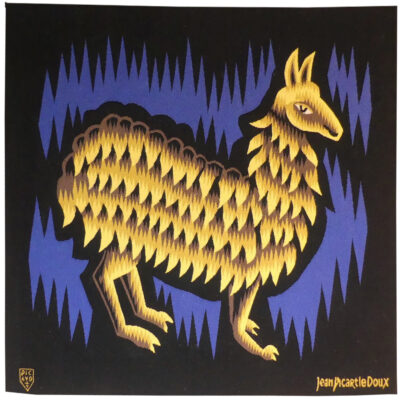
Tapisserie d'Aubusson tissée par l'atelier Picaud. Avec son bolduc signé, n°1/6. Circa 1980. Jean Picart le Doux est l'un des grands animateurs du renouveau de la tapisserie. Ses débuts dans le domaine datent de 1943 : il réalise alors des cartons pour le paquebot "la Marseillaise". Proche de Lurçat, dont il épouse les théories (tons limités, cartons numérotés,...), il est membre fondateur de l'A.P.C.T.(Association des Peintres-cartonniers de Tapisserie), et bientôt professeur à l'Ecole Nationale Supérieure des Arts Décoratifs. L'Etat lui commande de nombreux cartons tissés pour la plupart à Aubusson, pour certains aux Gobelins : les plus spectaculaires le seront pour l'Université de Caen, le Théâtre du Mans, le Paquebot France ou la Préfecture de la Creuse,.... Si les conceptions de Picart le Doux sont proches de celles de Lurçat, ses sources d'inspiration, ses thématiques, le sont aussi, mais dans un registre plus décoratif que symbolique, où se côtoient les astres (le soleil, la lune, les étoiles...), les éléments, la nature (le blé, la vigne, les poissons, les oiseaux...), l'homme, les textes,.... "La chèvre" (qui a tout d'un lama) est caractéristique des derniers petits cartons de l'artiste, à motif unique, proche de l'évocation des signes du Zodiaque. Bibliographie : Marthe Belle-Joufray, Jean Picart le Doux, Publications filmées d’art et d’histoire, 1966 Maurice Bruzeau, Jean Picart le Doux, Murs de soleil, Editions Cercle d'art, 1972 Cat. Exp. Jean Picart le Doux, tapisseries, Musée de Saint-Denis, 1976 Cat. Exp. Jean Picart le Doux, Musée de la Poste, 1980 -
The Grand Duke
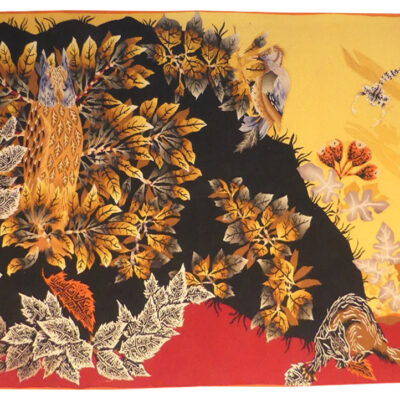
Lurçat's body of work is immense, but it is his role in the revival of the art of tapestry that has ensured his place in history. He began working with canvas in 1917, then collaborated with Marie Cuttoli in the 1920s and 1930s. His first collaboration with Les Gobelins dates back to 1937, when he discovered the Apocalypse tapestry in Angers, which inspired him to devote himself entirely to tapestry. He first tackled the technical issues with François Tabard, then, when he moved to Aubusson during the war, he defined his own system: large stitches, counted tones, numbered cartoons. A huge production then began (more than 1,000 cartoons), amplified by his desire to involve his painter friends, the creation of the A.P.C.T. (Association des Peintres-Cartonniers de Tapisserie) and his collaboration with the La Demeure gallery and Denise Majorel, then by his role as a tireless promoter of the medium throughout the world. His woven work bears witness to a specifically decorative art of imagery, in a highly personal, cosmogonic symbolic iconography (sun, planets, zodiac, four elements, etc.), stylized plants, animals (goats, roosters, butterflies, chimeras, etc.), stand out against a background without perspective (deliberately distanced from painting), and intended, in his most ambitious cartoons, to share a vision that is both poetic (he sometimes embellishes these tapestries with quotations) and philosophical (the major themes are addressed from the war onwards: freedom, resistance, fraternity, truth, etc.) and culminating in the "Chant du Monde" (Jean Lurçat Museum, former Saint-Jean Hospital, Angers), which was unfinished at the time of his death. Naturalistic representations of animals are unusual in Lurçat's work (Maingonnat comes to mind instead). But the flat colored backgrounds segment and distinguish the different species, in a contrasting compartmentalization characteristic of the artist. Bibliography: Tapisseries de Jean Lurçat 1939-1957, Pierre Vorms Editeur, 1957 Exhibition catalog: Lurçat, 10 ans après, Musée d'Art moderne de la ville de Paris, 1976 Exhibition catalog: Les domaines de Jean Lurçat, Angers, Musée Jean Lurçat et de la tapisserie contemporaine, 1986 Colloquium Jean Lurçat et la renaissance de la tapisserie à Aubusson, Aubusson, Musée départemental de la Tapisserie, 1992 Exhibition catalog Dialogues avec Lurçat, Musées de Basse-Normandie, 1992 Exhibition catalog Jean Lurçat, Simone Lurçat Donation, Academy of Fine Arts, 2004 Gérard Denizeau, Jean Lurçat, Liénart, 2013 Exhibition catalog Jean Lurçat au seul bruit du soleil, Paris, Galerie des Gobelins, 2016Aubusson tapestry woven by the Tabard workshop. With its ribbon. Circa 1950. -
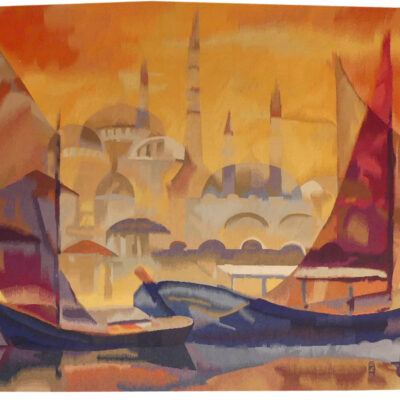
Byzantium
Aubusson tapestry woven by the Four workshop. With its bolduc, no. 3/6. Circa 1980. Toffoli devoted much of his time to tapestry with the Robert Four workshop from 1976 onwards, producing hundreds of cartoons. These feature the painter's characteristic post-Cubist transparencies and subjects. Indeed, Toffoli's tapestry is not dissimilar to his painting: Hagia Sophia and the Bosphorus guarantee the journey.