

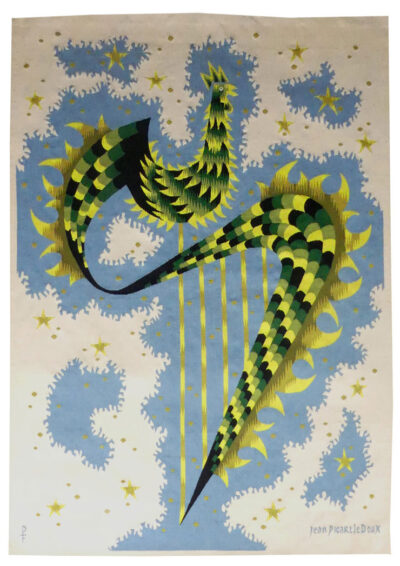
172 cm

  • Morning song

    Aubusson tapestry woven by the Pinton workshop. No. 5/6. 1965.
    Jean Picart le Doux was one of the leading figures in the revival of tapestry. He began working in this field in 1943, creating cartoons for the ocean liner La Marseillaise. Close to Lurçat, whose theories he embraced (limited tones, numbered cartoons, etc.), he was a founding member of the A.P.C.T. (Association des Peintres-cartonniers de Tapisserie) and soon became a professor at the Ecole Nationale Supérieure des Arts Décoratifs. The State commissioned him to produce numerous cartoons, most of which were woven in Aubusson, and some at Les Gobelins: the most spectacular were for the University of Caen, the Théâtre du Mans, the ocean liner France, and the Prefecture of Creuse. While Picart le Doux's designs were similar to those of Lurçat, so too were his sources of inspiration and themes, but in a more decorative than symbolic register, combining the stars (the sun, moon, stars, etc.), the elements, nature (wheat, vines, fish, birds, etc.), man, texts, etc. An amusing allegory of a rooster-harp, bright and joyful: while the title and theme echo Lurçat's concerns, the highly decorative nature of the cardboard is unique to Picart le Doux. Bibliography: Maurice Bruzeau, Jean Picart le Doux, Murs de soleil, Editions Cercle d'art, 1972, ill. no. 147 Cat. Exp. Jean Picart le Doux, tapestries, Musée de Saint-Denis, 1976 Cat. Exp. Jean Picart le Doux, Musée de la Poste, 1980
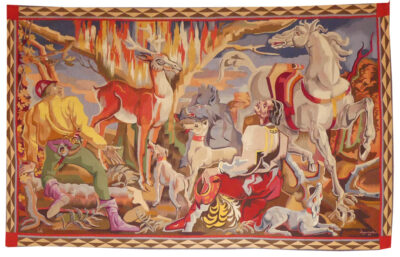
  • The Legend of Saint Hubert

     
    Aubusson tapestry woven in the Pinton workshop for the Compagnie des Arts Français. 1943.  
     
    Adnet, head of the Compagnie des Arts Français since 1928, wanted to restore tapestry to a prominent place in interior design, without imitating painting and limiting himself to a restricted color palette (in a similar approach to that of Lurçat). To this end, he enlisted the help of Despierre, Coutaud, Planson, and Brianchon. Passionate about monumental art (he also designed stained glass windows and mosaics, and was a teacher and then head of the mural art workshop at the Ecole Nationale des Arts Décoratifs), after these first commissions during the war, Despierre was regularly called upon by the Manufactures Nationales, which wove "fishing," "hunting," "maritime law," "industrial and commercial law," and more throughout the 1950s and 1960s.   The bold colors (the clothing of the figure on the left, worthy of Mannerism!) and the dense, monumental figures (typical of the period and the artist) should not obscure the meaning of the tapestry: a religious subject, a vehicle of faith and hope in a troubled period (Saint-Saëns and Lurçat also knew how to conceal the symbol behind the appearance). This is paradoxical, considering Adnet's essentially decorative concerns.   The Cité de la Tapisserie d'Aubusson has a copy of this tapestry, inverted and with a different border from ours; it is the one illustrated in the bibliography.     Bibliography: Cat. Exp. La tapisserie française du moyen âge à nos jours (French tapestry from the Middle Ages to the present day), Musée d'Art Moderne, Paris, 1946, no. 247 Cat. Exp. Tapisseries contemporaines (Contemporary tapestries), Musée de Lyon, 1956, reproduced in fig. no. 3 Heng Michèle, Aubusson et la renaissance de la tapisserie (Aubusson and the renaissance of tapestry), History of art No. 11, 1990, Varia, Fig. 5 page 69 Exhibition catalog Jean Lurçat, compagnons de route et passants considérables, Felletin, Eglise du château, 1992, reproduced on pp. 20-21 Cat. Exp. Tapestry and expressions of the sacred, Aubusson, Departmental Tapestry Museum, 1999, reproduced on p.36 Cat. Exp. Fantastic rides, the horse in tapestry, Aubusson, Departmental Tapestry Museum, 2008, reproduced on p.63
  • Composition

     
    Tapisserie, probablement d'Aubusson. Circa 1970.
    Si le passage à l’abstraction s’opère chez Lanskoy à partir des années 40, ses premiers cartons datent des années 50 : ils seront donc tous abstraits. D’abord tissé à Aubusson chez Picaud, il donne ensuite la plupart de ses cartons à Maurice Chassagne (dont aucune marque d’atelier, ni bolduc ne figurent jamais sur les tapisseries qu’il a tissées), mais il fut aussi tissé aux Manufactures Nationales, et « Consolation » orna le paquebot « France », preuve de l’inscription de l’artiste dans l’histoire de l’art français. Protagoniste majeur de l’abstraction lyrique, défendu par les principales galeries de l’époque (Jeanne Bucher, Louis Carré), Lanskoy, dont la peinture foisonnante s’épanouit parfois en fééries de couleurs (les roses, les mauves, les oranges… ont régulièrement droit de cité) parvient à se passer de ses caractéristiques empâtements lorsqu’il s’agit d’être tissé. De même, le lyrisme des formes y apparaît souvent plus contenu.
     
Go to top