180 cm

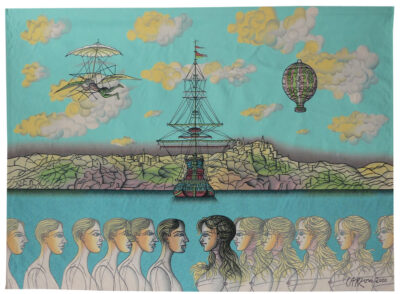
  • Travel, the 3rd millennium

     
    Aubusson tapestry woven in Jacques Fadat's workshop. Certificate signed by the artist, no. 1/1. 2000.
          Although he first made his name as a painter of large-scale decorations (particularly for the stage), Carzou's forays into tapestry are relatively rare. This cartoon displays the artist's characteristic style, with intertwining lines illustrating dreamlike subjects: the theme is taken from Carzou's (only) cartoon woven by the Manufactures Nationales, "L'invitation au voyage" (Invitation to Travel). At the dawn of the 3rde At the turn of the millennium (and a few months before his death), the artist, a regular critic of modern society, had a unique vision of future travel, focused on ballooning and sailing.
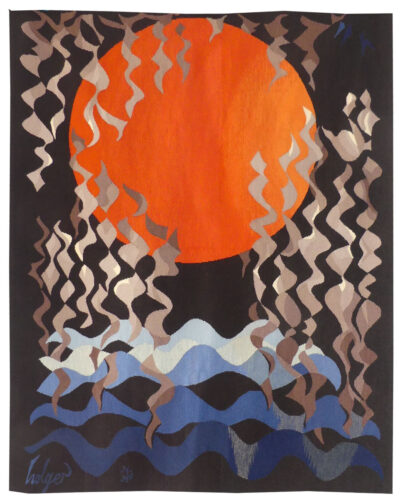
  • Nachtsonne (Night Sun)

      Tapestry woven by Münchener Gobelin Manufaktur. With ribbon signed by the artist. Circa 1970.    
    Holger studied at the National School of Decorative Arts in Aubusson and worked with Lurçat before the latter's death in 1966. He produced numerous dreamlike cartoons woven in Aubusson. Now based in the United States, he remains a tireless advocate and witness of modern tapestry, organizing exhibitions and conferences on the subject. Some of his cartoons have been woven in the two active factories in Germany, in Nuremberg and Munich, using the Aubusson technique.
     
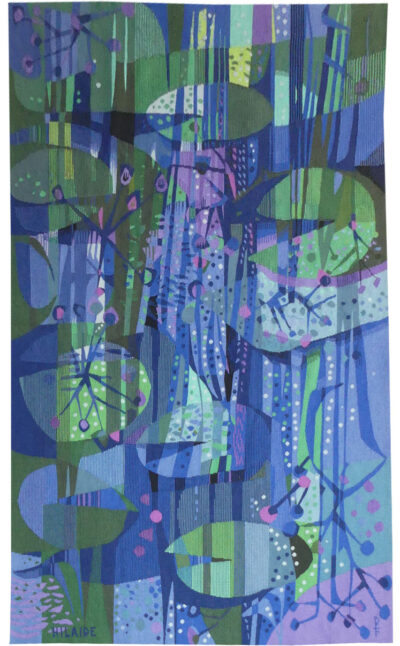
  • Water lilies

     
    Aubusson tapestry woven in the Pinton workshops for the Verrière gallery. With its bolduc, no. 4/6. 1968.  
    Attracted by large surfaces, under the influence of Untersteller at the School of Fine Arts, Hilaire produced numerous murals. Logically, from 1949 onwards, along with many other artists inspired by Lurçat (he would join him in the A.P.C.T., Association des Peintres-Cartonniers de Tapisserie), he produced numerous cartoons (several dozen), some of which were woven in Beauvais or at the Gobelins. Hilaire appropriated the subject, preempted by Monet, in his usual cubist (and tending towards abstraction) style, made up of lines and circular shapes in an exalted blue and green color palette. His passion for horticulture, to which he had aspired in his youth, echoes that of Monet in Giverny.  
    Bibliography: Exhibition catalog, Hilaire, woven works, Galerie Verrière, 1970, ill. Exhibition catalog, Hilaire, from line to light, Georges de la Tour Departmental Museum in Vic-sur-Seille, 2010.
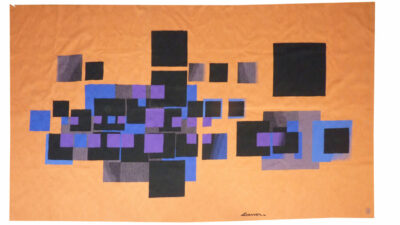
  • Galatea

    Aubusson tapestry woven by the Picaud workshop. With its ribbon signed by the artist, no. 1/4. 1970.
    Loewer created his first cardboard work in 1953; his creations were initially figurative before he shifted (like Matégot) towards abstraction, which was exclusively geometric in Loewer's case. He composed more than 180 cardboard works, most of which were woven by his friend Raymond Picaud. Woven in a single copy according to the catalogue raisonné, "Galathée" is representative of the artist's style around 1970, whose recurring plastic sign became the square, used in superimpositions. Bibliography: Claude Loewer, l’évasion calculée: travaux de 1939 à 1993, catalogue raisonné des tapisseries de 1953 à 1974, Sylvio Acatos, Charlotte Hug, Walter Tschopp, and Marc-Olivier Wahler, Artcatos, 1994, no. 120
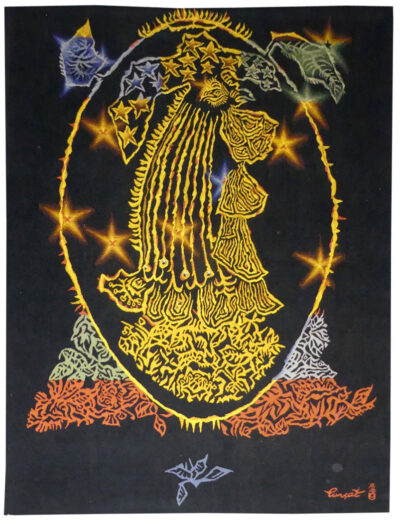
  • Fire pheasant

    Aubusson tapestry woven by the Tabard workshop. With its bolduc signed by the artist. Circa 1960.
    Lurçat's body of work is immense, but it is his role in the revival of the art of tapestry that has ensured his place in history. He began working with canvas in 1917, then collaborated with Marie Cuttoli in the 1920s and 1930s. His first collaboration with Les Gobelins dates back to 1937, when he discovered the Apocalypse tapestry in Angers, which inspired him to devote himself entirely to tapestry. He first tackled the technical issues with François Tabard, then, when he moved to Aubusson during the war, he defined his own system: large stitches, counted tones, numbered cartoons. A huge production then began (more than 1,000 cartoons), amplified by his desire to involve his painter friends, the creation of the A.P.C.T. (Association des Peintres-Cartonniers de Tapisserie) and his collaboration with the La Demeure gallery and Denise Majorel, then by his role as a tireless promoter of the medium throughout the world. His woven work bears witness to a specifically decorative art of imagery, in a highly personal, cosmogonic symbolic iconography (sun, planets, zodiac, four elements, etc.), stylized plants, animals (goats, roosters, butterflies, chimeras, etc.), stand out against a background without perspective (deliberately distanced from painting) and, in his most ambitious cartoons, are intended to share a vision that is both poetic (he sometimes embellishes these tapestries with quotations) and philosophical (the major themes were addressed as early as the war: freedom, resistance, fraternity, truth, etc.) and whose culmination was to be the "Chant du Monde" (Jean Lurçat Museum, former Saint-Jean Hospital, Angers), which was unfinished at the time of his death. This rooster's head in profile appears in various cartoons ("Feux bleus," "La chanson de Roland," etc.): it appears there, with its mandorla, as if in reserve, radiant against the black background. The title, changing from rooster to pheasant, allows for a play on words on "faire feu" (to fire). Bibliography: Tapisseries de Jean Lurçat 1939-1957, Pierre Vorms Editeur, 1957 Exhibition catalog: Lurçat, 10 ans après, Musée d'Art moderne de la ville de Paris, 1976 Exhibition catalog: Les domaines de Jean Lurçat, Angers, Musée Jean Lurçat et de la tapisserie contemporaine, 1986 Colloque Jean Lurçat et la renaissance de la tapisserie à Aubusson, Aubusson, Musée départemental de la Tapisserie, 1992 Cat. Expo. Dialogues avec Lurçat, Musées de Basse-Normandie, 1992 Cat. Expo. Jean Lurçat, Simone Lurçat Donation, Academy of Fine Arts, 2004 Gérard Denizeau, Jean Lurçat, Liénart, 2013 Exhibition catalog Jean Lurçat au seul bruit du soleil (Jean Lurçat to the Sound of the Sun Alone), Paris, Galerie des Gobelins, 2016
Go to top