-
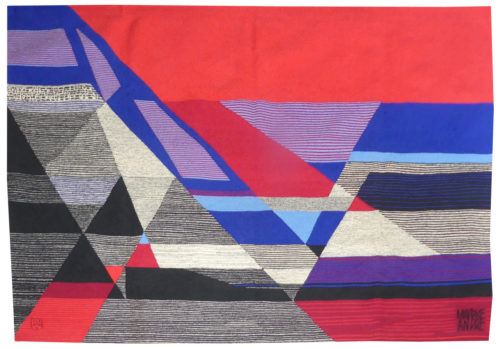
Maurice André settled in Aubusson for the duration of the second world war. A founding member of the group “Tapisserie de France” and a member of the A.P.C.T. (Association des Peintres-Cartonniers de Tapisserie), he developed a personal style, different from that of Lurçat, characterised by rigorous, cubist-influenced flat areas of colour, often using a limited palette ; he received large-scale public commissions for the Council of Europe in Strasbourg (“L’Europe unie dans le Travail et la Paix”) or for the French pavilion at the Brussels Exhibition in 1958 (“La Technique moderne au service de l’Homme”). Gradually (as with Wogensky and Prassinos,...) his style evolved towards more abstraction, firstly lyrical and then more and more geometric, in a way very similar to Matégot. Always geometric (going as far as pure abstraction in the 1970’s) Maurice André’s style is here limited to a cubic, kaleidoscopic vision : we can distinguish birds, roots, waves and perhaps a cage, …, all themes that can also be found in Lurçat’s work.Aubusson tapestry woven in the Picaud workshop. With signed label. 1974.
-
La cage aux oiseaux (the bird cage)
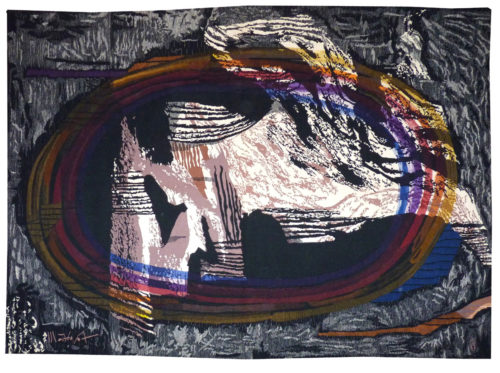
Aubusson tapestry woven in the Pinton workshop. With label, n°1/6. Circa 1980. Although in his youth Lorjou was a silk fabric designer and an artist specialising in large formats used as posters for exhibitions (“la peste en Beauce” “the plague in the Beauce” 1953, measuring 250 x 360cm for example), he only turned his hand to tapestry design relatively late on : maybe he felt that his rather rough and ready style was somehow inappropriate to being woven (it is noteworthy that other artists to whom he was close, Rebeyrolle, Mottet, Sébire, ... never had their work realised as tapestries). In the 1970’s his style moved away from expressionism to something more dreamlike and it is at this point that he gave a few designs to the Pinton workshop. The colours employed, the bird motifs are all characteristic of Lorjou’s work in the 1970’s. The effects created by the thickness of the paint used are rendered in the tapestry by the use of different stitches. -
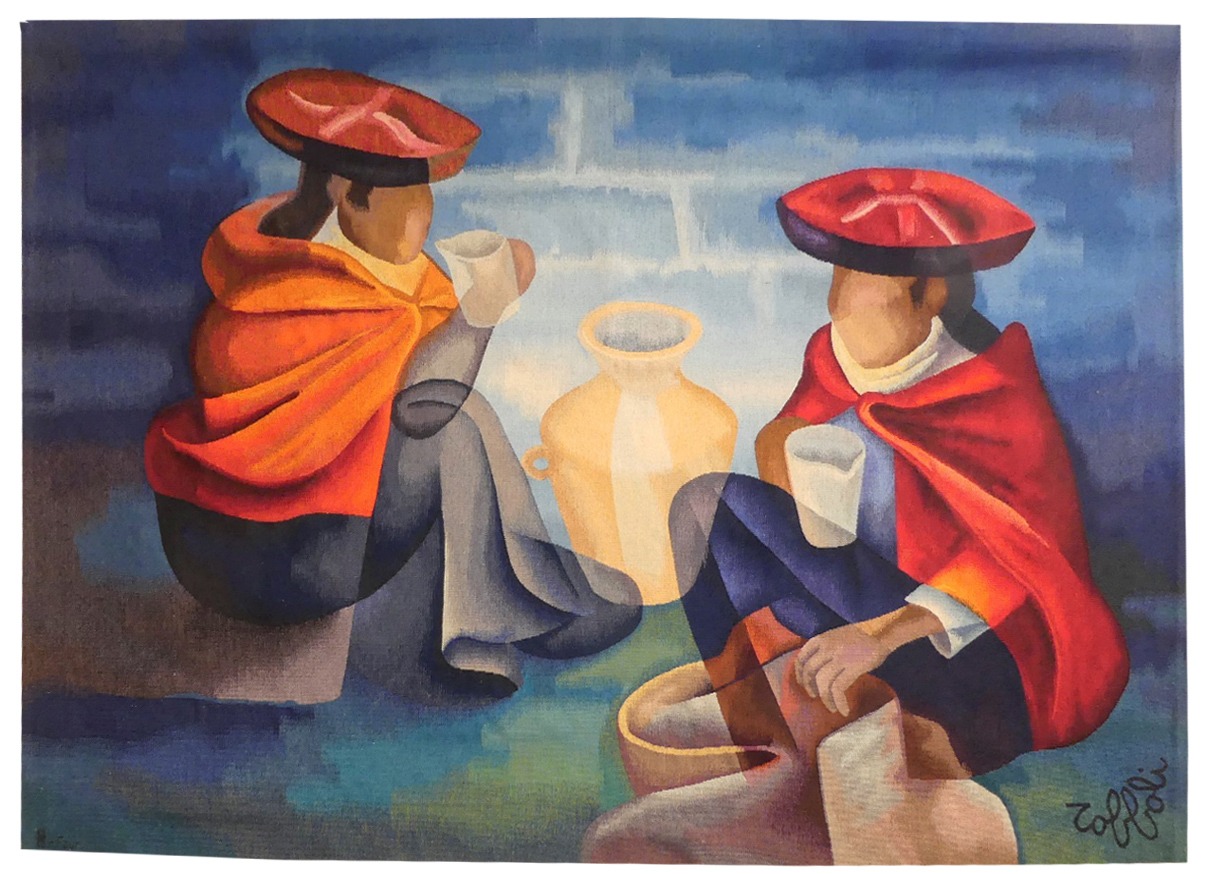
Marchands (Traders)
Toffoli produced a large number of tapestries in collaboration with the Robert Four workshop from 1976 onwards, designing several hundred cartoons. In them we find post-cubist transparent effects which are characteristic of the artist, as indeed are the subjects treated. Thus Toffoli’s tapestries do not differ from his painting : travelling for inspiration, here he illustrates scenes observed during his travels in South America.Aubusson tapestry woven by the Four workshop. With signed label, n°EA2/2. Circa 1980.